
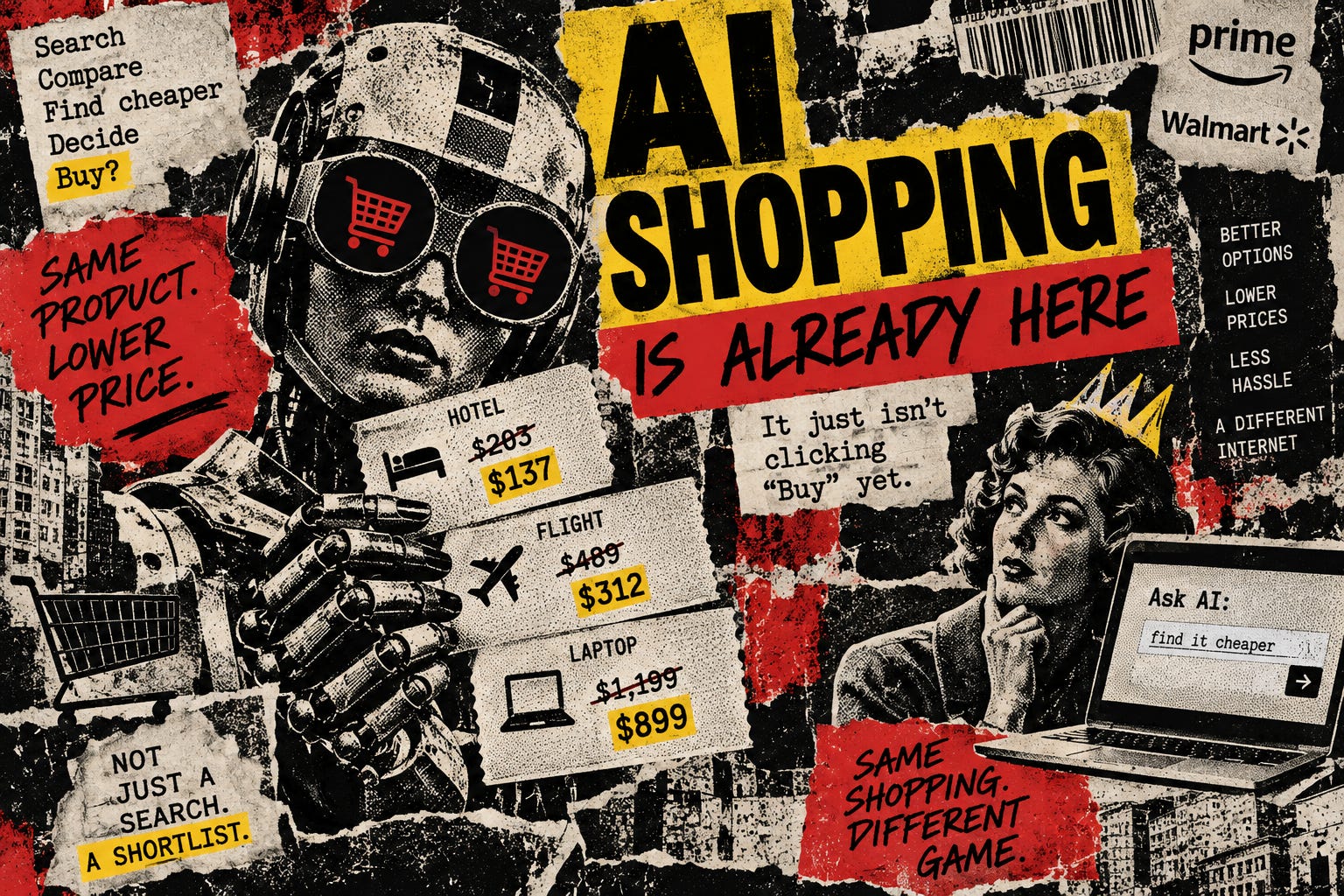
I already have AI agents constantly monitoring hotel and flight prices. And I regularly give Codex a very sophisticated financial instruction: “Find it cheaper.” It works surprisingly often.
Not in the futuristic sense where an autonomous agent controls my credit card, books a hotel, negotiates with Lufthansa and sends me the boarding pass while I sleep. We are not quite there yet.
The useful part happens earlier. The AI checks alternatives, compares prices, changes dates, notices that the same thing is cheaper somewhere else, and reduces a messy field of options to a few sensible choices. While everyone is waiting for the great moment when an AI agent finally presses BUY, it is already changing commerce one step before that. And that step may be more important.
AI is becoming the shopping research layer
A new PYMNTS Intelligence report found that about 23% of U.S. consumers had used generative AI for product discovery during the previous 12 months.
More interestingly, researching and comparing products was the only one of ten shopping activities they measured that showed meaningful growth. PYMNTS based the report on 11 independent monthly surveys from September 2025 through July 2026. The July sample included 2,301 U.S. consumers and was balanced by age, gender, education and income. That seems much more important to me than whether ChatGPT can currently complete a checkout.
Buying something online is already easy. We solved the button. What remains annoying is everything before the button. Which laptop? Which hotel? Which insurance plan? Is the €900 version actually better than the €650 one? Is this “discount” real? Does another retailer sell exactly the same thing for 20% less?
Traditional search gives you links. Marketplaces give you filters. Reviews give you several hundred strangers with radically different standards for what constitutes “excellent battery life.”
AI is unusually well suited to turning this pile into a decision.
“Find cheaper” may be a killer app
Another PYMNTS survey makes the price-comparison angle even clearer.
During the overlapping Amazon Prime Day and Walmart Deals events in 2026, 21% of participants said they had used an AI chatbot or assistant while shopping. Among those AI users, 38% used it to compare prices across retailers and 36% used it to find deals. Another 32% researched product features.
Important caveat: that 38% is not 38% of all shoppers.
The relevant subgroup contained 423 people who used AI during the sales events, from a broader June 2026 survey of 2,160 U.S. consumers. Still, this looks very familiar to how I already use AI.
I rarely need an agent to physically execute the final purchase. I need it to tell me that the hotel I am about to book is €47 cheaper two streets away.
The transaction is trivial. The comparison is work.
This is uncomfortable for retailers
The old retail funnel was relatively friendly to the retailer.
Google search. Click. Retailer website. Browse. Compare a few things inside the store. Buy. AI can collapse much of that into one conversation.
“I need a lightweight laptop under €1,200, mostly for travel, good battery, 32 GB RAM, available in France. Give me three options and tell me where each is cheapest.”
By the time I arrive on a retailer’s website, most of the shopping journey may already be over.
I am not visiting to discover what they sell. I am arriving with a product name, a target price and perhaps the knowledge that their competitor currently sells it for €70 less.
That changes the retailer’s problem considerably.
It used to be: How do we rank high enough to get the click?
Increasingly it may become: How do we get into the AI’s shortlist at all?
PYMNTS makes essentially the same point: discovery, education and comparison can increasingly happen before a shopper ever reaches the merchant, leaving only a small set of candidates by the time the click occurs.
SEO got you onto the search results page.
The next problem is getting the machine to understand your product well enough to recommend it.
Retailers may lose the top of the funnel
This is where I think the commercial impact gets interesting.
A retailer can optimize its own site beautifully. Perfect product page. Excellent recommendations. Fantastic comparison widget. A lovingly designed conversion funnel. And I may never see any of it.
If my AI assistant gives me three products and your product is not among them, your conversion rate is zero. Not low. Zero. The decision happened elsewhere.
That creates a strange new intermediary layer between consumers and merchants.
Google spent decades becoming the gateway to the web. Amazon became a gateway to products. Booking became a gateway to hotels. AI assistants have a plausible route to becoming a gateway to decisions. They do not necessarily need to own the checkout to have enormous influence over the transaction.
The valuable position may be deciding which three things the consumer considers in the first place.
But the data does not yet prove AI is changing where people buy
There is a caveat worth keeping. Both PYMNTS studies are based on what respondents say they did. They are not transaction logs.
We therefore cannot take these numbers and conclude that AI changed 23% of American purchasing behavior, or that 38% of shoppers switched stores because ChatGPT found a lower price.
The surveys do not tell us precisely how often an AI recommendation changes the final merchant, product or amount spent. Self-reported behavior is useful evidence of adoption. It is not the same thing as observing actual purchases. That distinction matters. But even with that limitation, the direction seems worth watching.
Consumers are finding a job for AI that is both boring enough to delegate and valuable enough to keep using. That is usually a good combination.
Agentic commerce may arrive backwards
The popular vision of agentic commerce starts at the end: AI buys things for you.
I suspect adoption may happen in the opposite direction.
First: “Explain my options.”
Then: “Compare these.”
Then: “Find it cheaper.”
Then: “Keep watching the price.”
Then: “Tell me when I should buy.”
And eventually: “Fine, just buy it.”
By the time the final step arrives, the economically important transition may already have happened.
The agent has become the layer between demand and the market. It knows what I want. It knows my constraints. It knows what I consider expensive. And it can inspect far more alternatives than I am willing to.
The checkout button is the least interesting part.
We already know how to click buttons.
The real shift is that increasingly, AI may decide what is worth clicking on.
Conflict declared first, and it is a sharp one here: I build communication infrastructure for AI agents at Dial, so I sell into exactly the step you are calling trivial. Discount accordingly.
Your main argument I think is right and I am not going to argue with it. The comparison is the work, the shortlist is the position worth holding, and the retailer's problem really has changed from ranking to being legible enough to make the three. I also note you put a real caveat on your own evidence, which is rarer than it should be.
The part I want to press on is the sequence at the end. Explain, compare, find cheaper, keep watching, tell me when, and eventually fine, just buy it. You read that as adoption arriving backwards, which treats all six as points on one ramp.
I do not think the last one is on the ramp. The first five are the same capability applied harder: read a lot, hold constraints, compare, summarise. The sixth is not an extension of any of that, and the evidence is in how they have moved. Over the last two years the first five got dramatically better, and they got better because the models did. The sixth is sitting roughly where it was. If it were the far end of the same curve, better models would have dragged it some distance by now. It has not moved because nothing about it was ever a model problem.
What is actually there, from the side I work on: an agent at that step does not meet a slightly harder checkout. It meets the path built for the case where the system cannot establish who is acting - the one-time code, the step-up, the confirm-in-your-banking-app. That path is not leftover friction design has not got round to removing. It is where the liability sits, and it fires precisely on the signal an agent generates.
Which is why I think your conclusion is stronger than the way you pitched it. You present the shortlist as where value moved first, with the implication that the rest follows. If the last step is held by a control that is nobody's roadmap item, and the people who could open it are merchants whose problem, by your own argument, is now getting into the three rather than letting a machine authenticate, then the shortlist is not where value moved first. It is where value is stuck, and plausibly for years. That is a much better claim than a sequencing one.
Two against myself. If you are right that the comparison is the work, the market for letting agents transact is smaller than someone in my position would like, and I would be selling plumbing for the least valuable step in the chain. And the honest uncertainty: the parties who could change this have the most to gain from the volume, so if they move, what I am describing is a few years of standards work rather than anything structural, and your ordering is simply right.
One thing only your own setup can answer. You have agents monitoring prices constantly. Has one ever got as far as needing to prove something about you, rather than just failing to find something - and when it did, did you take that part over yourself, or stop pointing it at that job?