
AI Will Not Kill Work. It Will Move the Bottleneck.
Economies do not revolve around jobs. They revolve around scarcity. AI changes what becomes scarce, and that changes where the money goes.
One of the few genuinely sane things I have read lately about AI and labor markets comes from Alex Imas, in a piece called What will be scarce?
The reason it is sane is that it avoids the usual theatrical nonsense: either “AI destroys all jobs and civilization collapses,” or “AI makes everyone infinitely productive and therefore everything is fine.” Instead, it starts with a far more useful question: what remains scarce? That is the real economic question, because economics is not fundamentally about employment. It is about decision-making under scarcity. Where scarcity lives, demand follows. Where demand follows, money follows.
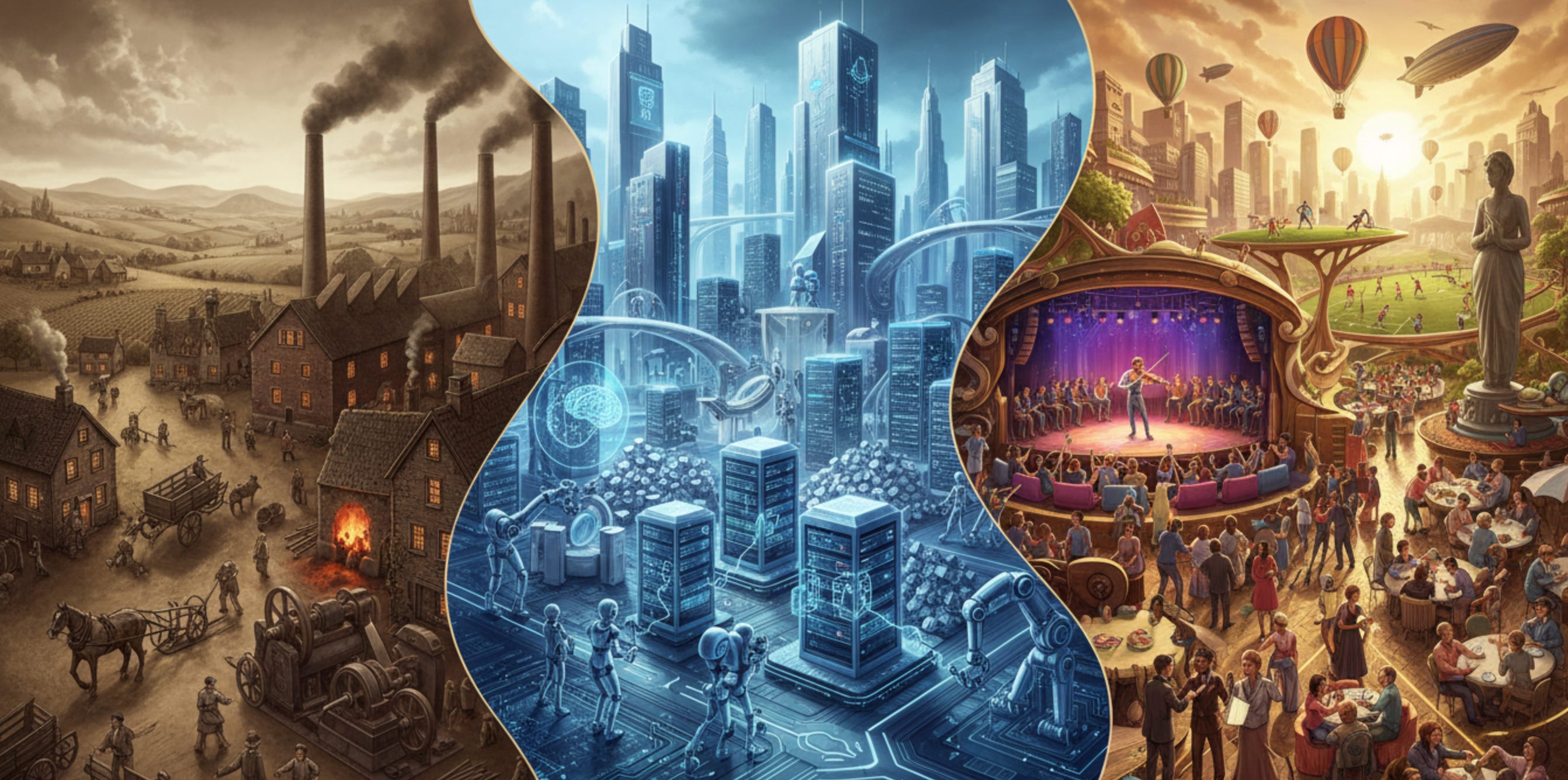
Thousands of years ago, scarcity was food. So agriculture and hunting dominated. Then scarcity shifted toward making things: machines, appliances, housing, manufactured goods. As productivity rose, agriculture shrank as a share of employment and output, not because food stopped mattering, but because it stopped being the bottleneck. Imas’s argument is that AI and robotics may now do something similar to both physical and digital production. As more of that becomes cheap and abundant, the bottleneck moves again, toward things that do not scale cleanly: attention, trust, status, uniqueness, taste, social meaning, participation, and human presence. He calls this the relational sector.
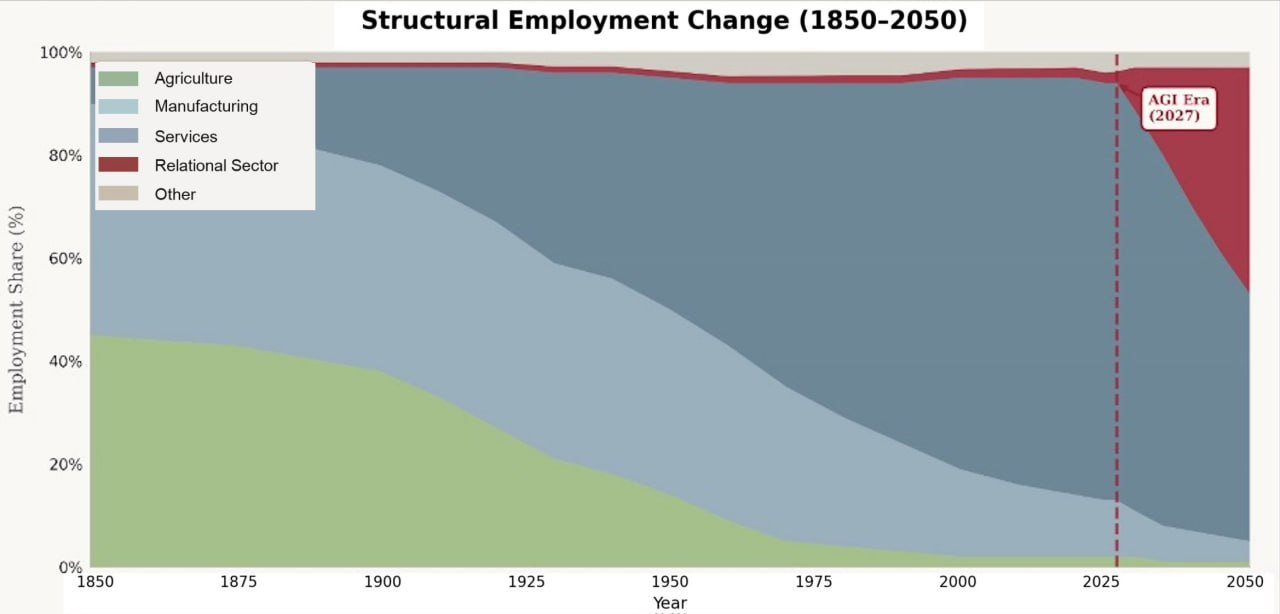
This is the bit people consistently miss. They talk about the economy as though it were a fixed pie with a fixed menu of jobs. It is not. It never was. When automation makes one category radically cheaper, people do not simply sit on the savings and stare at the wall. Their preferences shift. As real incomes rise, spending moves toward categories with higher income elasticity, which is economist-speak for “the things people want more of once they can afford to stop worrying about basic stuff.” Imas points to structural-change research showing that these income effects, not just price effects, drive most long-run sectoral reallocation. In plain English: people do not merely buy more when they get richer. They buy different.
And what do people choose when mass-produced goods become trivial to obtain? Not more identical robot-made beige sludge. They choose what other people cannot easily have. Better experiences. Better education. Better entertainment. Better travel. Better access. Better curation. Better belonging. Better stories. Better status. The point is not just utility. It is distinction. It is provenance. It is the human fingerprint. Imas leans on René Girard’s idea of mimetic desire here: once basic needs are satisfied, people increasingly want things because of what they mean socially, not merely because of what they do functionally. That makes the human element part of the product itself.
Which is why the future does not look, to me, like “humans become economically irrelevant.” It looks more like this: anything that can be turned into a commodity will be turned into a commodity, and then priced accordingly. And once that happens, value migrates elsewhere. Just as agriculture collapsed from a dominant share of employment to a tiny one while food output soared, the relative importance of routine physical and digital production may fall even as total abundance rises. GDP does not vanish. It rearranges itself around the new bottlenecks.
This has two consequences, one for now and one for later.
Now, the highest-value skill is the ability to automate. Full stop. If you can use AI and robotics to compress costs, remove friction, and automate entire workflows, departments, industries, or sectors, you are standing directly on the current bottleneck. That is where the money is.
Later—and by later I mean years and decades, not next Thursday—the premium shifts toward what remains difficult to automate even in a world drowning in intelligence and output. That means designing experiences, creating trust, building real social capital, shaping taste, offering unique human presence, and making things whose value depends precisely on not being generic.
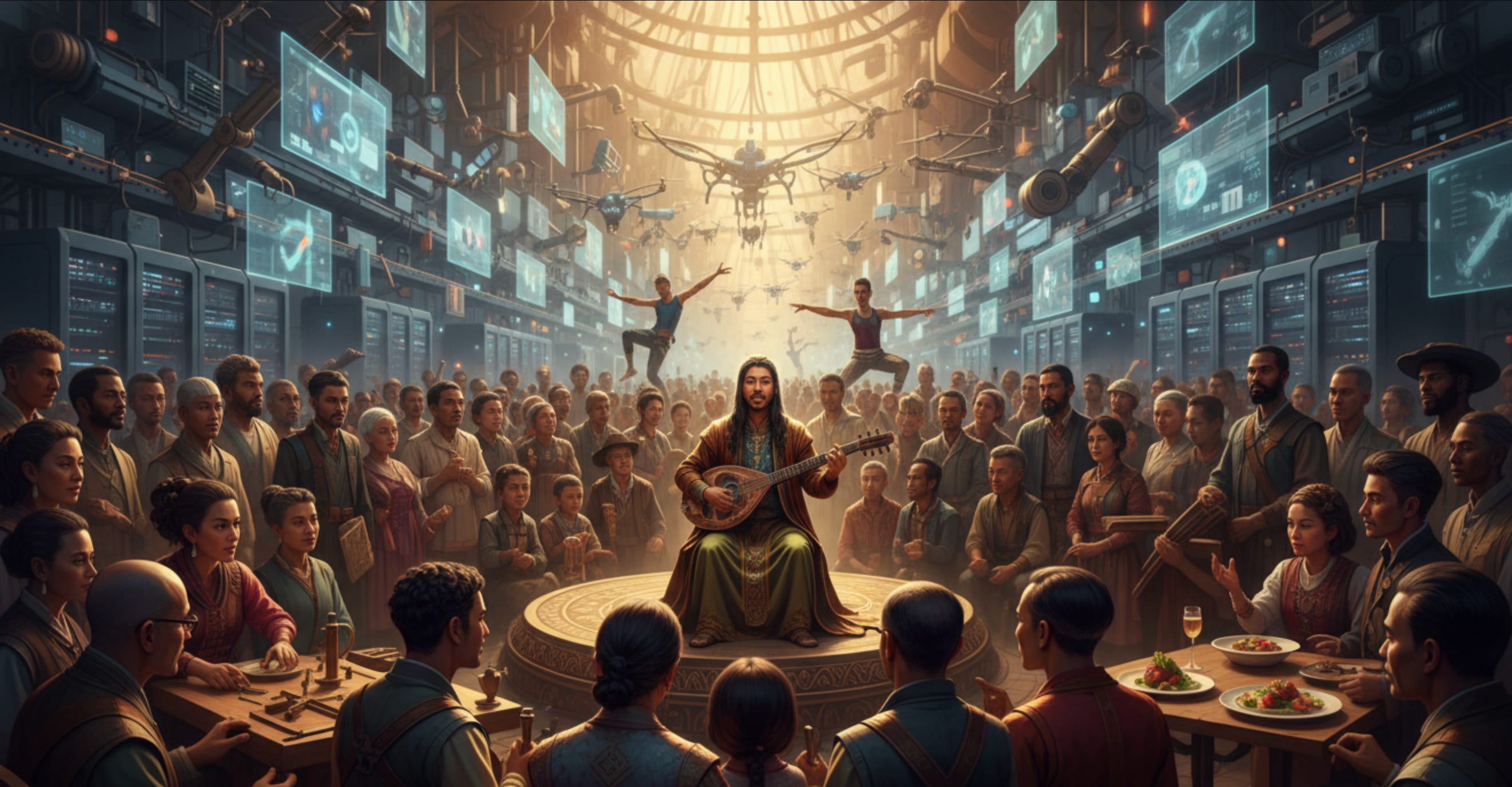
In other words: today, the money goes to the people building abundance. Tomorrow, more of it goes to the people shaping scarcity.
This is also why the most childish question in AI economics is “Will there still be jobs?” Of course there will be jobs. The more interesting question is which human constraints will still matter once production itself is cheap. The answer is unlikely to be “filling out spreadsheets by hand.” It is far more likely to be the messy, expensive, gloriously irrational realm of human desire: relationships, reputation, exclusivity, live experience, identity, meaning, trust.
Because economies are not employment machines.
They are scarcity-tracking systems.
And AI’s real trick is not that it ends economics. It is that it moves the bottleneck.