
First We Removed the Keyboard. Now Meta Wants to Remove the Microphone.
Meta’s Brain2Qwerty shows how AI and brain-computer interfaces are moving computing closer to raw intention, with enormous promise and equally serious questions about privacy, control, and human agenc
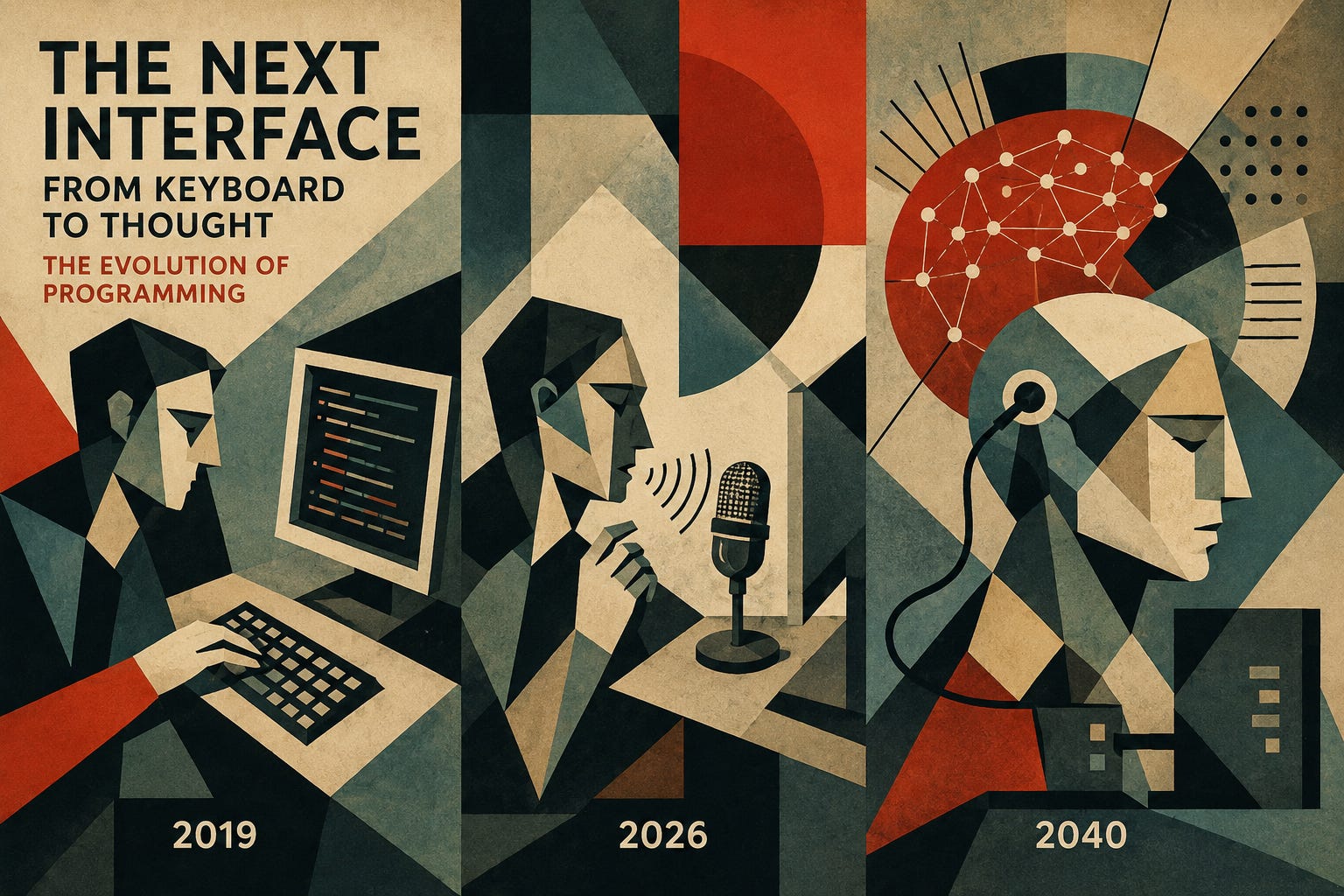
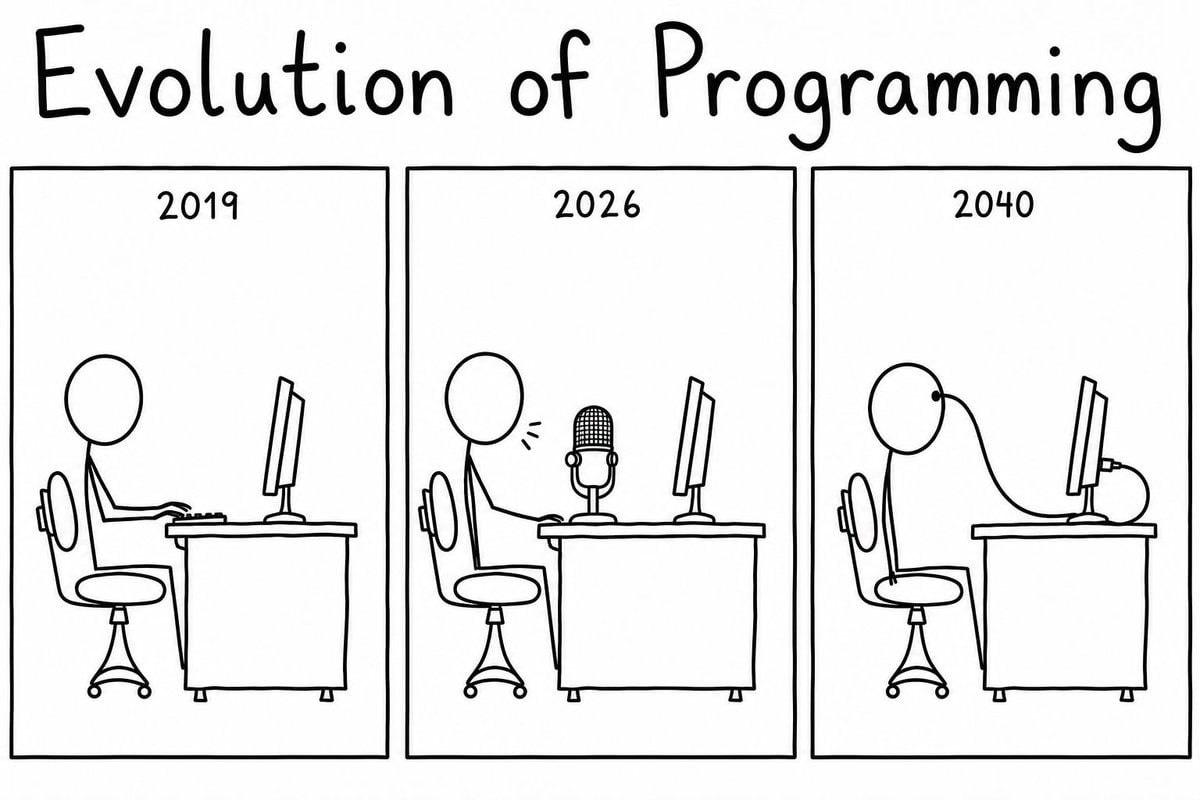
There is a meme going around about the evolution of programming.
In 2019, the engineer sits at a desk and types.
In 2026, the keyboard has disappeared and the engineer dictates instructions into a microphone.
By 2040, the microphone is gone too, replaced by a cable running directly from the engineer’s head into the computer.
Like many good memes, it is ridiculous mainly because it appears to be a product roadmap.
After Meta’s latest Brain2Qwerty announcement, the frontier has moved one step closer to the final panel.
Meta has presented Brain2Qwerty v2, a non-invasive brain-to-text system that uses magnetoencephalography, or MEG, and deep learning to decode complete sentences from brain activity in real time. The average word accuracy reached roughly 61%, while the best participant reached 78%. No brain implant. No surgery. Just an enormous magnetic scanner, a great deal of training data, and enough machine learning to make the keyboard feel slightly nervous. (ai.meta.com)
Before everyone throws away the mechanical keyboard and orders a telepathy helmet, there is a fairly important caveat.
Brain2Qwerty does not sit quietly beside your head while you think, “perhaps I should refactor authentication,” and then produce a clean pull request.
The experiments record brain activity while participants actively produce typed sentences. The original system learned to associate EEG or MEG patterns with keystrokes and language structure. The newer version removes the need to know the exact timing of each keypress and instead generates sentences from continuous MEG recordings. That is a major technical step, but it is still neural decoding under controlled conditions, not unrestricted mind reading. (Nature)
Still, it is remarkable. And for me, slightly personal.
Back around 2010–2011, I worked with Professor Alexander Kaplan at Moscow State University testing early brain-computer interfaces and trying to understand whether they had any commercial future. They did work.
You could type, select commands, or play simple games such as chess without moving your hands. The interface responded to changes in brain activity created through concentration and attention. This was not telepathy either.
It was closer to learning how to produce a recognizable neural signal on command, while the machine patiently tried to distinguish that signal from blinking, muscle tension, electrical noise, bad electrode contact, and the fact that the human brain is not especially interested in behaving like a USB device. The systems were fascinating.
They were also slow, noisy, inaccurate, physically awkward, and extremely easy to ruin by thinking about almost anything else.
You could control a computer with your brain. You simply had to sit still, concentrate hard, accept that the computer might misunderstand you, and occasionally wonder whether using a mouse had really been such a terrible burden.
Brain2Qwerty changes two important parts of that equation.
Better Signals
The first improvement is the use of magnetoencephalography. Traditional EEG measures electrical activity through electrodes placed on the scalp. It is relatively affordable and portable, but signals become distorted as they pass through tissue and bone. It is rather like listening to a conversation through several walls while someone operates a vacuum cleaner nearby.
MEG measures the magnetic fields generated by neural activity. Those magnetic signals are less distorted by the skull, offering much cleaner temporal and spatial information.
The difference in the original Brain2Qwerty results was substantial. The model achieved a character error rate of 32% using MEG, compared with 67% using EEG. The best MEG participants reached a 19% character error rate, and some previously unseen sentences were decoded perfectly. (Nature) This is a serious improvement. It is also why the technology is currently about as consumer-ready as a particle accelerator.
The MEG system used for this work is a large, expensive machine that operates in a magnetically shielded environment. You are not placing one next to the coffee machine in a WeWork. Meta acknowledges that both decoding quality and hardware practicality remain major obstacles. The current system still makes too many errors for everyday communication, and the scanner is far too large and costly for ordinary clinical or consumer deployment. (ai.meta.com)
So the meme’s 2040 panel may require an unusually spacious home office.
Better Decoding
The second improvement is the AI model itself. Brain signals are not letters waiting politely to be collected. The brain does not emit a clean “Q,” followed by a “W,” followed by an “E.” It generates overlapping patterns associated with intention, language formation, motor planning, movement, prediction, correction, and context.
The decoding model therefore has to do several jobs. It must extract useful patterns from short windows of raw brain activity. It must connect those patterns across time. And it must use a language model to transform noisy character-level guesses into plausible sentences.
Brain2Qwerty v1 combined a convolutional module, a transformer operating at sentence level, and a pretrained language model that corrected the output. In some cases, the system even reconstructed the intended sentence despite the participant making typographical mistakes while typing. (Nature)
Brain2Qwerty v2 goes further by decoding directly from continuous MEG recordings. It combines hierarchical modules for characters, words, and sentences and was trained on approximately 22,000 sentences from nine participants, with around ten hours of recording per person. (ai.meta.com)
The model is not merely detecting fingers moving. It is learning the broader neural process through which a sentence becomes language, then motor intention, then action. That is what makes the result more interesting than a very expensive invisible keyboard.
This Is Not About Replacing Typing Yet
The obvious consumer fantasy is hands-free computing.
Write documents through thought. Control interfaces without movement. Program without a keyboard. Reply to email while lying motionless on a sofa, finally achieving the dream toward which office technology has been marching for decades. But the more immediate and important use case is medical.
Thousands of people lose the ability to speak or move after strokes, accidents, ALS, and other neurological conditions while retaining the cognitive ability to form language.
Invasive brain implants have already restored remarkably effective communication for some patients, but they require neurosurgery and bring obvious medical risks.
A non-invasive system, even one that is less accurate, could eventually offer a safer and more scalable alternative.
Meta explicitly frames Brain2Qwerty as a path toward communication for people with brain lesions that prevent speech or movement. The company has also released training code for both versions, while its research partners are releasing the earlier dataset to support further work. (ai.meta.com) This is the serious version of the story. Not programmers becoming too lazy to move their fingers.
People who cannot communicate regaining a channel to the outside world. The difference is considerable.
The Machine Still Needs the Human
One of the most interesting aspects of the project is how much the language model contributes.
Raw neural signals are ambiguous. The language model supplies probability, grammar, context, and correction. If the neural decoder produces something close to a sentence, the LLM can reconstruct what a person most likely intended. That is useful. It is also philosophically awkward. Because when a brain interface produces a sentence, whose sentence is it? The person’s? The decoder’s? The language model’s best guess?
If the user intended one phrase but the model “corrected” it into something more statistically likely, the output may be fluent and wrong. Autocorrect is irritating when it changes one word in a message. It becomes rather more consequential when it is positioned between the brain and the world.
A useful BCI will therefore need more than high average accuracy. It will need uncertainty indicators, confirmation mechanisms, personal adaptation, error correction, strong privacy protections, and a clear distinction between decoded intent and model completion.
Otherwise we may build a system that speaks beautifully on your behalf while occasionally deciding that you meant something else.
Which, admittedly, would make it very similar to social media.
The Privacy Question Arrives Early
Brain data is not merely another biometric. A fingerprint tells a system who you are. Brain activity may reveal something about what you are attempting to say, perceive, remember, or do.
The current Brain2Qwerty setup is far from covert mind reading. Participants cooperate, perform a known task, spend hours in a huge scanner, and generate training data specific to the decoding problem. But technical limitations have a habit of becoming temporary: Sensors shrink. Models improve. Training requirements fall. Generalization gets better. And eventually a medical interface becomes an input device, an accessibility tool becomes a consumer feature, and a helpful neural signal becomes another data stream somebody would quite like to monetize.
We already struggle to regulate browsing histories, location data, microphones, cameras, and advertising profiles. Neural data makes those arguments look pleasantly simple.
The time to discuss cognitive privacy is before brain interfaces fit inside a fashionable headset, not after a platform updates its terms of service.
From Brain Signal to Interface
The broader trend is clear. Computing interfaces keep moving closer to intention. Command line interfaces required exact syntax. Graphical interfaces translated intention into clicks. Touchscreens removed the mouse. Voice interfaces removed the hands. Agents remove individual commands by letting us specify goals. Brain-computer interfaces attempt to remove even the spoken request. Each step reduces friction. Each step also removes a layer where humans traditionally checked what they were doing. Typing gives you time to formulate. Speaking is faster and less structured. Delegating to an agent moves execution away from direct control. Decoding neural activity moves the interface closer to impulses that may not yet have become fully formed statements. This is why the most important engineering question may not be how quickly a machine can decode intention. It may be how much distance we still want between intention and action.
Sometimes friction is irritating. Sometimes friction is thought.
The Verdict
Brain2Qwerty is not a telepathy machine. It does not read arbitrary thoughts. It does not let a programmer throw away the keyboard tomorrow. And unless your desk includes a multimillion-dollar magnetically shielded brain scanner, it will not improve your home-office setup. But it is still an important breakthrough.
Meta has shown that a non-invasive system can decode continuous sentences from brain activity at a level approaching territory once reserved for implanted interfaces. It does this by combining cleaner MEG signals, far more training data, and AI models that reconstruct language from an extremely noisy biological source.
Fifteen years ago, I watched people move cursors and choose letters through concentration using ordinary EEG. It felt extraordinary, but also painfully limited. The basic idea has not changed. Measure the brain. Find a repeatable signal. Teach the machine what it means.
What changed is the quality of the signal and, above all, the machine’s ability to decode it. The keyboard disappeared from the meme in 2026. The microphone may disappear eventually too. But the real achievement will not be an engineer writing code while sitting perfectly still. It will be someone who has lost the ability to speak being able to say what they mean again. And when that happens, the rather silly meme will have predicted something genuinely profound.