
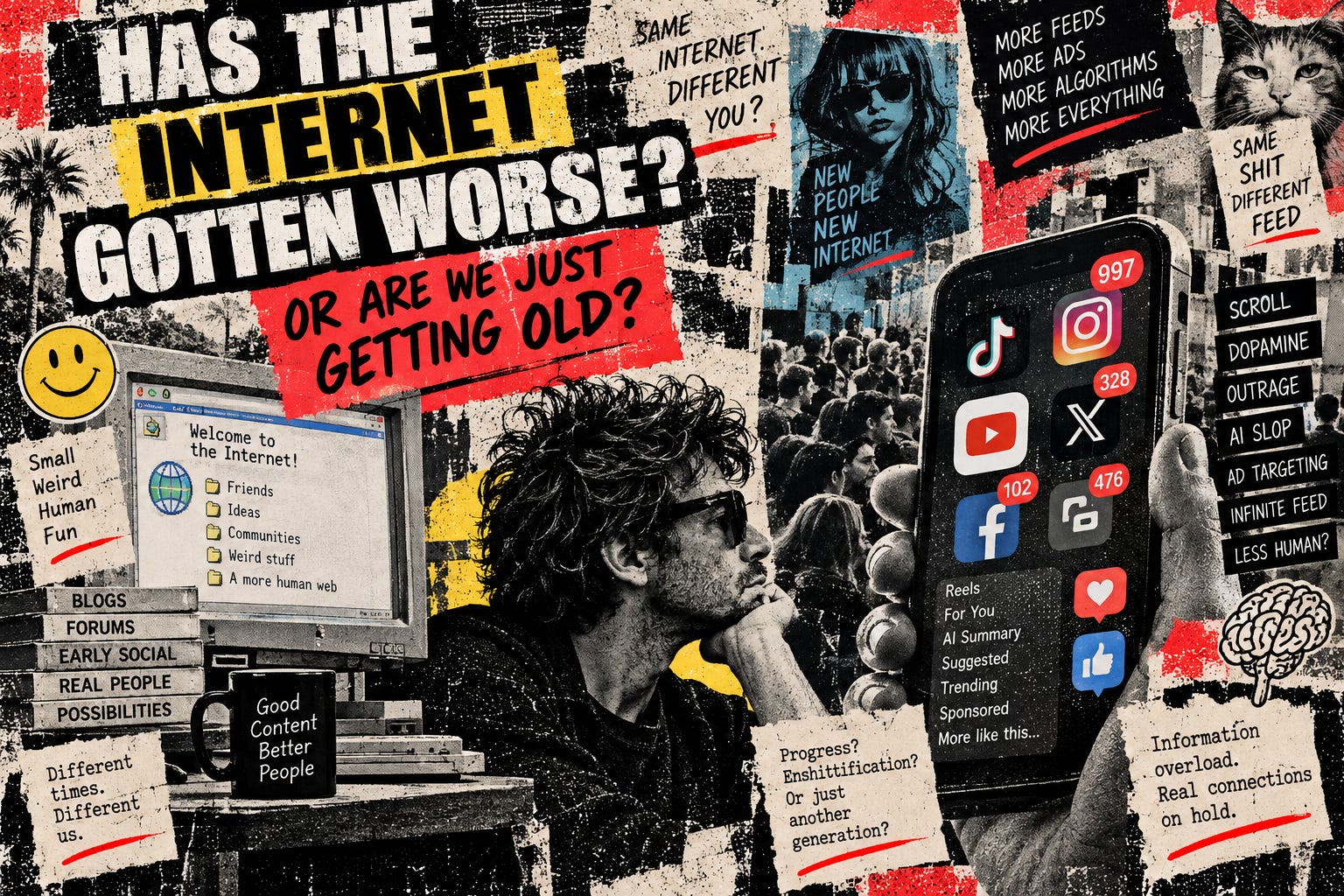
a16z recently published a column by NYU professor Ruby Thelot arguing something mildly offensive to anyone over thirty: the internet is probably fine. You’re just getting old.
His target is the now-famous idea of “enshittification,” the term coined by Cory Doctorow to describe what happens when platforms begin by serving users, then gradually optimize for advertisers, monetization and whatever quarterly metric is currently keeping management awake.
The story is familiar. Facebook used to show your friends. Instagram used to show photographs. Google used to show websites. Then somebody discovered there was money involved.
Feeds became recommendation machines. Search results filled with ads, marketplaces and summaries. Platforms learned that an angry person remains on the screen surprisingly long. Everything became optimized, monetized, personalized and, somehow, less pleasant.
We complain that the old internet was better. Thelot’s argument is basically: Was it? Or was it simply better for you?
The Internet We Miss Was Built Around Our Age Group
This is the uncomfortable part. The people most nostalgic for the “good internet” are often the people who happened to be young when that version of the internet was being invented. Blogs. Forums. Early Twitter. Facebook when you actually knew everyone in your feed. Instagram before Reels. We remember those products as simpler, stranger and more human. But perhaps that’s partly because we were the target demographic.
Meanwhile, younger users are perfectly happy communicating through short video, private Discord servers, memes incomprehensible to adults, group chats and whatever application appeared approximately fourteen minutes ago.
From their perspective, the internet may not be collapsing. It may simply have moved on. This happens with almost every cultural technology.
Every generation eventually discovers that music has become terrible, movies have become stupid, young people dress incorrectly and nobody knows how to have a proper conversation anymore.
Usually around the same age their parents made the same discovery. So perhaps “enshittification” is partly just nostalgia with a better name.
The Numbers Aren’t Obviously on the Side of Collapse
Thelot points to the American Customer Satisfaction Index. In 2026, satisfaction with social media reportedly rose by one point to 75 out of 100. Not exactly evidence of civilization collapsing under the unbearable weight of Instagram Stories. There is a caveat, though. These surveys are quite good at measuring whether products function.
Does the app load? Is it reliable? Are features useful? Is the interface usable? On those dimensions, modern social networks are extraordinary pieces of engineering. Instagram almost never crashes. YouTube can deliver 4K video to billions of devices. TikTok appears to know what you want before you do, which is either excellent product design or a reasonable opening scene for a dystopian film.
Technically, the internet is probably better than ever. That isn’t necessarily the complaint.
The Problem May Be That Everything Works Too Well
Modern platforms have become extremely good at one task: keeping you there.
That creates a strange distinction between product satisfaction and life satisfaction.
You can think:
This app works perfectly.
while simultaneously thinking:
Why the hell did I just spend 94 minutes looking at it?
The product succeeded. Perhaps you didn’t. And I think this is where the enshittification argument still has teeth.
People aren’t only complaining that Facebook buttons moved or Instagram added another feature nobody requested.
There is a broader exhaustion. Too much information. Too many recommendations. Too much content. Too much content that looks suspiciously like every other piece of content. Too much AI slop. Too much outrage calibrated to your exact political and emotional profile. Too much personalization gradually turning your view of the world into an extremely comfortable prison.
The algorithms have become better at serving us. Maybe that’s precisely the problem.
We Are Also Simply Tired
There is another possibility that I suspect is simultaneously true. We have been doing this for twenty years.
Of course scrolling becomes less magical. The first time you discover strangers on the other side of the world who love the same obscure thing you do, the internet feels miraculous.
After the 40,000th argument with an anonymous avatar explaining geopolitics beneath a video of a cat, some of the novelty has faded. A growing appetite for “anti-brainrot” content makes sense. So does the growth of running clubs, dinners, niche conferences, local communities, book clubs and events whose primary technological innovation is that everybody is physically in the same room.
Maybe we’re not abandoning the internet. Maybe we’ve finally discovered that the internet isn’t a complete substitute for having a life.
An impressive breakthrough.
I Think Doctorow and Thelot Can Both Be Right
The platforms really have changed. Their incentives changed as they matured. Advertising became more important. Growth slowed. Public companies needed more revenue per user. Recommendation systems replaced social graphs because recommendation systems produce more engagement. Platforms gained more power over creators and businesses dependent on them. That part isn’t imaginary. But users changed too.
The twenty-year-old who loved spending every evening online is now forty, has children, ten projects, back pain and an increasingly strong preference for dinner with six interesting people over 700 algorithmically selected opinions.
The same platform can objectively become more commercial while also subjectively becoming less interesting because your priorities changed.
These explanations aren’t mutually exclusive.
The More Interesting Question Is What Comes Next
I’m less interested in deciding whether Facebook officially qualifies as enshittified than in what people do with the feeling that something is wrong.
Do we get smaller networks? More private groups? Paid communities? More newsletters? More direct relationships between creators and audiences? More offline clubs built through online discovery? Perhaps the next internet isn’t another gigantic feed. Maybe it’s a collection of much smaller spaces where you know why you’re there and can leave when you’re done.
That would be a fairly radical innovation by 2026 standards.
So, Is the Internet Worse?
Probably. Also probably not.
It’s faster, richer, more useful, more reliable and more powerful than anything we had twenty years ago. It’s also noisier, more manipulative, more commercialized and better at consuming every spare second you give it. And we are older.
All of those things can be true at once.
So perhaps the correct answer isn’t: “The internet used to be better.”
It’s: “The internet used to fit me better.”
Which is a considerably less satisfying complaint because there is nobody obvious to blame.
Except time. Anyway. Do we keep fighting for the old internet? Or do we finally hand TikTok to the kids and go outside?