
How to Build an Agent That Actually Gets Better Over Time
The model is only one place an agent can learn. The faster path is improving the harness, preserving context, and capturing real user corrections.
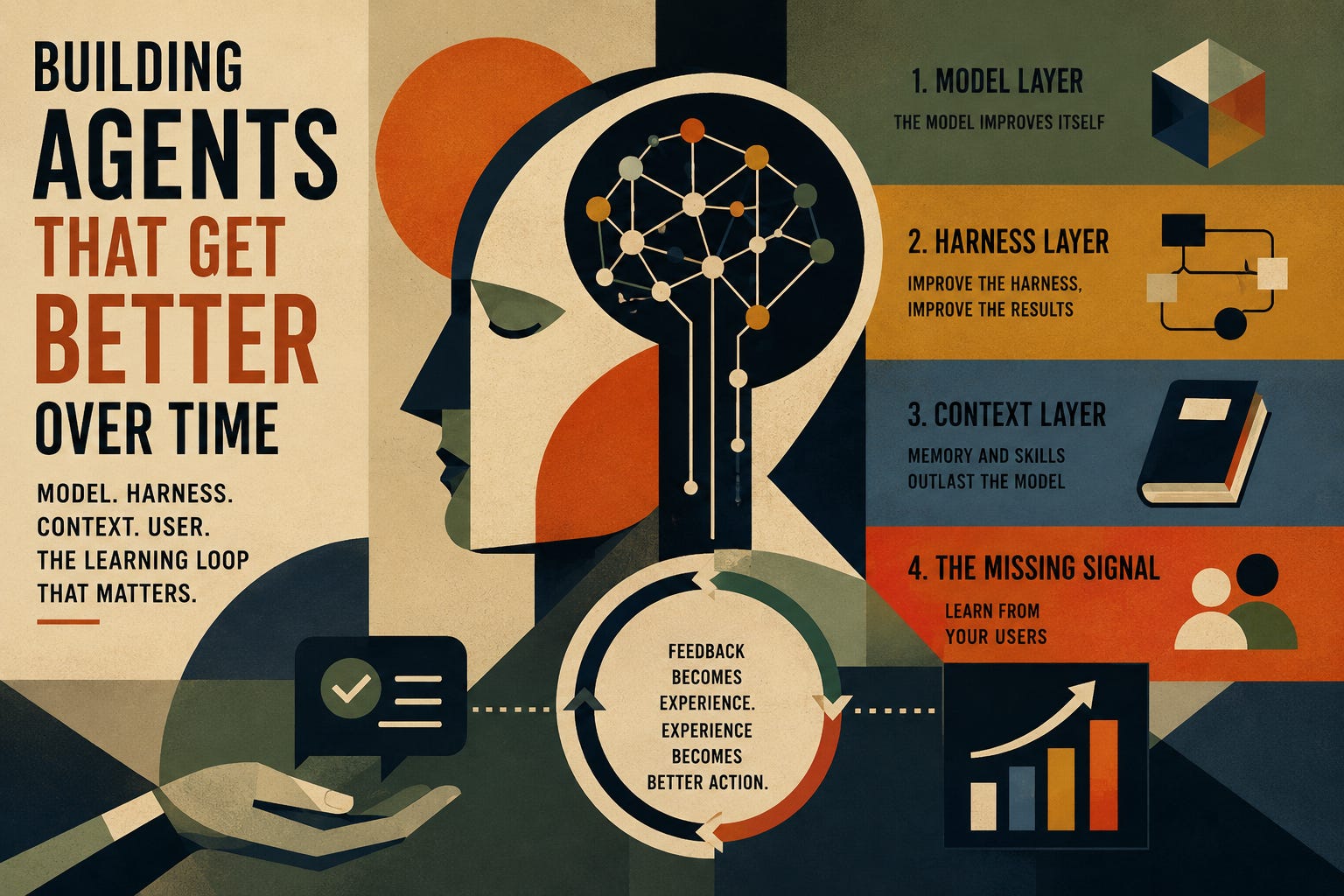
Most “self-learning agents” are not self-learning. They are agents with a memory file, a dramatic name, and the same tragic ability to make the same mistake next Tuesday. This is not because the idea is bad. The idea is excellent.
An agent that improves over time is the difference between a chatbot with tools and a real piece of infrastructure. The question is where the learning happens. There are three obvious layers. And one missing signal people keep forgetting.
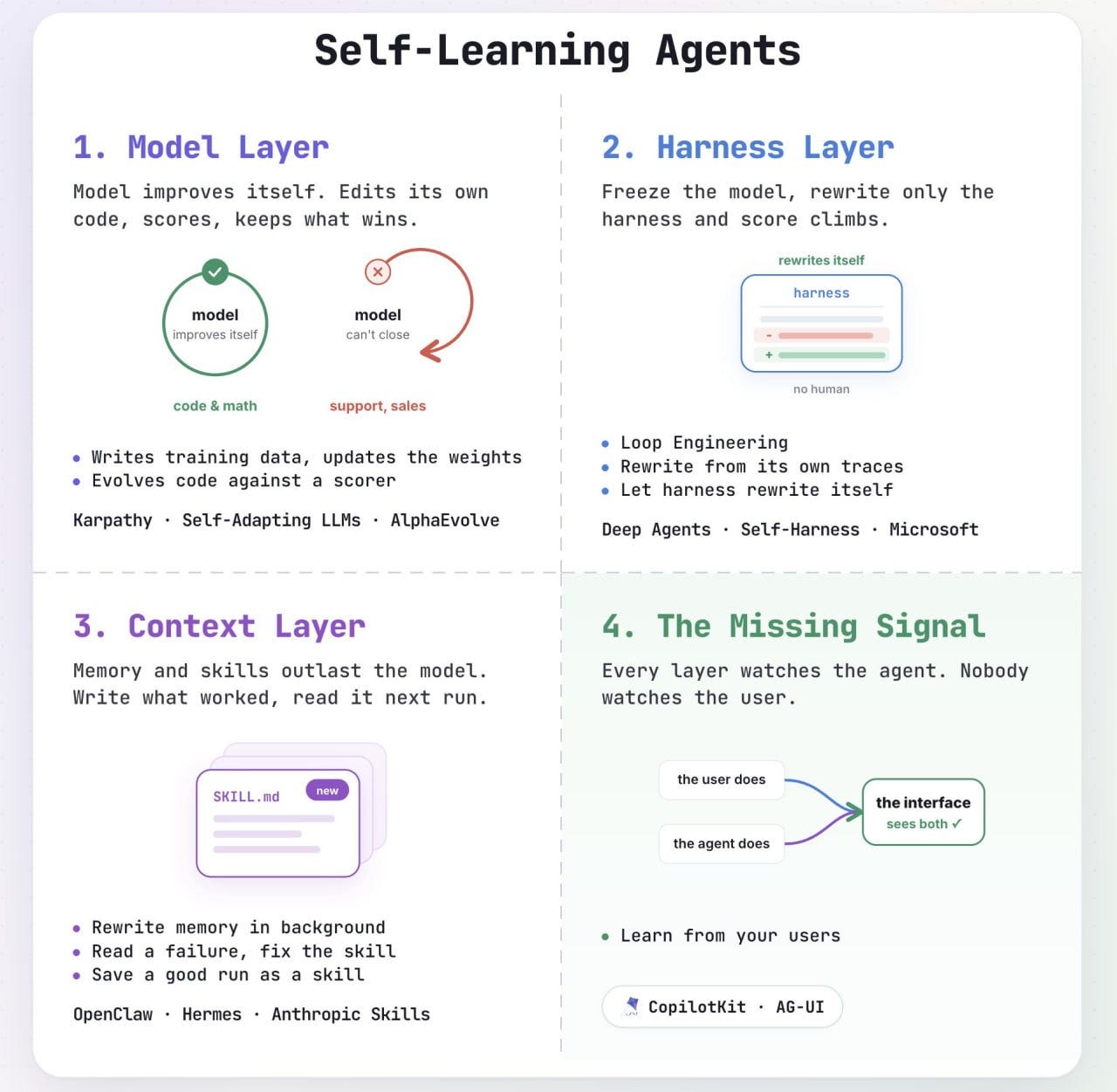
1. The Model Layer
This is the glamorous version.
The model improves itself. It generates training data. It updates weights. It evolves against a scorer. It gets better at code, math, tool use, reasoning, and everything else that makes benchmark charts go up and investors make noises usually associated with champagne. This can work. But mostly for domains where right and wrong are brutally clear.
Code either passes the test or it does not. Math either checks out or it does not. A formal proof either holds or collapses in a small puff of academic smoke. That is why this layer belongs mostly to large labs.
You need training infrastructure. You need evaluation. You need clean reward signals. You need serious compute. And you need a way to stop the thing from optimizing the wrong target with the moral confidence of a tax loophole.
For most teams, improving the model weights is not where the practical action is. It is the expensive mountain in the distance.
Lovely view. Not where you start building the house.
2. The Harness Layer
This is where things get useful quickly.
The harness is everything wrapped around the model: steps, tools, permissions, safety checks, evaluators, retry logic, memory loading, test execution, logging, and the general machinery that prevents your agent from behaving like an overexcited intern with shell access.
The model can stay frozen. The harness improves. And suddenly the agent becomes much better. This is the part people underestimate because it is not sexy. It sounds like plumbing. But plumbing is exactly what stops civilization from smelling like a medieval alley.
A better harness can make the agent: run the right tests; use the right tools; ask for confirmation before dangerous actions; save progress; route tasks to the right subagent; verify its own work; stop after repeated failure; recover from bad assumptions; avoid touching half the repository because it “noticed an opportunity for improvement.”
This is also the easiest place to get fast results. You do not need to train a new model. You need to rewrite the workflow around it.
A bad agent says: “Give me a task and I will improvise.”
A good harness says: “Here is the task. Here are the tools. Here are the limits. Here is the scoring function. Here is what counts as done. Here is where to record what happened. Here is when to stop.”
That is not prompt engineering. That is operational design.
3. The Context Layer
The context layer is even simpler.
It is what the agent remembers. Not in the mystical AGI sense. In the boring practical sense.
What worked last time? What failed? Which command should never be run? Which API behaves strangely? Which customer always means “monthly active accounts” when they say “users”? Which repo folder contains the real implementation and which one is a haunted museum? This is where skills, memory files, project notes, runbooks, and reusable procedures matter.
The model does not need to become smarter in the abstract. It needs to stop rediscovering the same facts. That alone is a massive improvement.
A useful agent should write down its own lessons: “This test fails unless the database seed runs first.” “Do not edit this generated file.” “When the user asks for a production build, run these three checks.” “The previous implementation failed because the API silently paginates at 100 records.” “The good solution used this smaller function, not the large refactor.” This is the easiest starting point for most builders.
Before dreaming about self-modifying models, make the agent preserve useful experience. Memory and skills are not decoration. They are how the agent stops being born yesterday every morning.
The Missing Signal: The User
Now comes the part many systems miss.
The agent should learn from the user. Not just from traces. Not just from tests. Not just from whether a benchmark score went up.
From the moment when a real person says:
“No, not like that.”
“You misunderstood the goal.”
“That answer is technically correct but useless.”
“This is not how we talk to customers.”
“This code works but violates our architecture.”
“Do this shorter.”
“Never suggest that option again.”
That is gold.
Real user correction is one of the richest signals an agent can get, because it contains taste, context, standards, expectations, and hidden business logic. The harness can watch the agent. The context can record what happened. The evaluator can score the output. But the user sees the actual mismatch between the agent’s work and reality.
If your system throws that signal away, your agent is not self-learning. It is self-forgetting.
What a Self-Learning Agent Should Do
A practical self-learning loop does not need to be mystical. It can be very simple.
The agent completes a task. The user corrects it. The system captures the correction.
A background process classifies the lesson.
Is it procedural? - “Next time, follow these steps.”
Is it semantic? - “This term means X in this company.”
Is it episodic? - “This specific user prefers Y.”
Then the system decides where to store it: A skill file. A memory note. A harness rule. A prompt instruction. A test. A retrieval snippet. A warning. A new evaluator criterion.
The next run reads that lesson. And the agent becomes slightly less stupid. Not enlightened. Not sentient. Just less stupid in the exact way that matters. That is progress.
The Real Moat
This is where the business moat appears. Not in having access to the same frontier model everyone else can call through an API. Not in saying “agentic” on the landing page, though apparently this is now mandatory by law.
The moat is in accumulated operational knowledge.
The agent that has seen your users, your workflows, your edge cases, your corrections, your product constraints, your tone, your failures, and your weird little internal rules becomes harder to copy.
A generic agent can be replicated. An agent that has learned from thousands of real interactions inside your product is something else. That is not just an assistant. That is organizational memory with tools.
The Verdict
If you want an agent that gets better over time, do not begin by trying to train the model. That is like deciding you need better coffee and buying a rainforest.
Start where the leverage is closer. Improve the harness. Improve the context. Capture user corrections. Turn good runs into skills. Turn failures into rules. Turn repeated confusion into memory. Let the agent learn from the work it actually does, not from some imaginary benchmark paradise where every answer is either green or red.
The model belongs to the labs. The harness belongs to you. The context belongs to you. The user feedback definitely belongs to you. And that is where most self-learning agents will become useful long before anyone ships a tiny god in a box.
I had a team that held “robot wars” between different bits of code. We had a policy agent that would assess two different robots tasked with the same thing and the policy agent would “kill” the lower performing code and promote the one that was better. I’ve built something similar into my current platform where agents monitor other agents and then assign development agents the work to improve the work.