
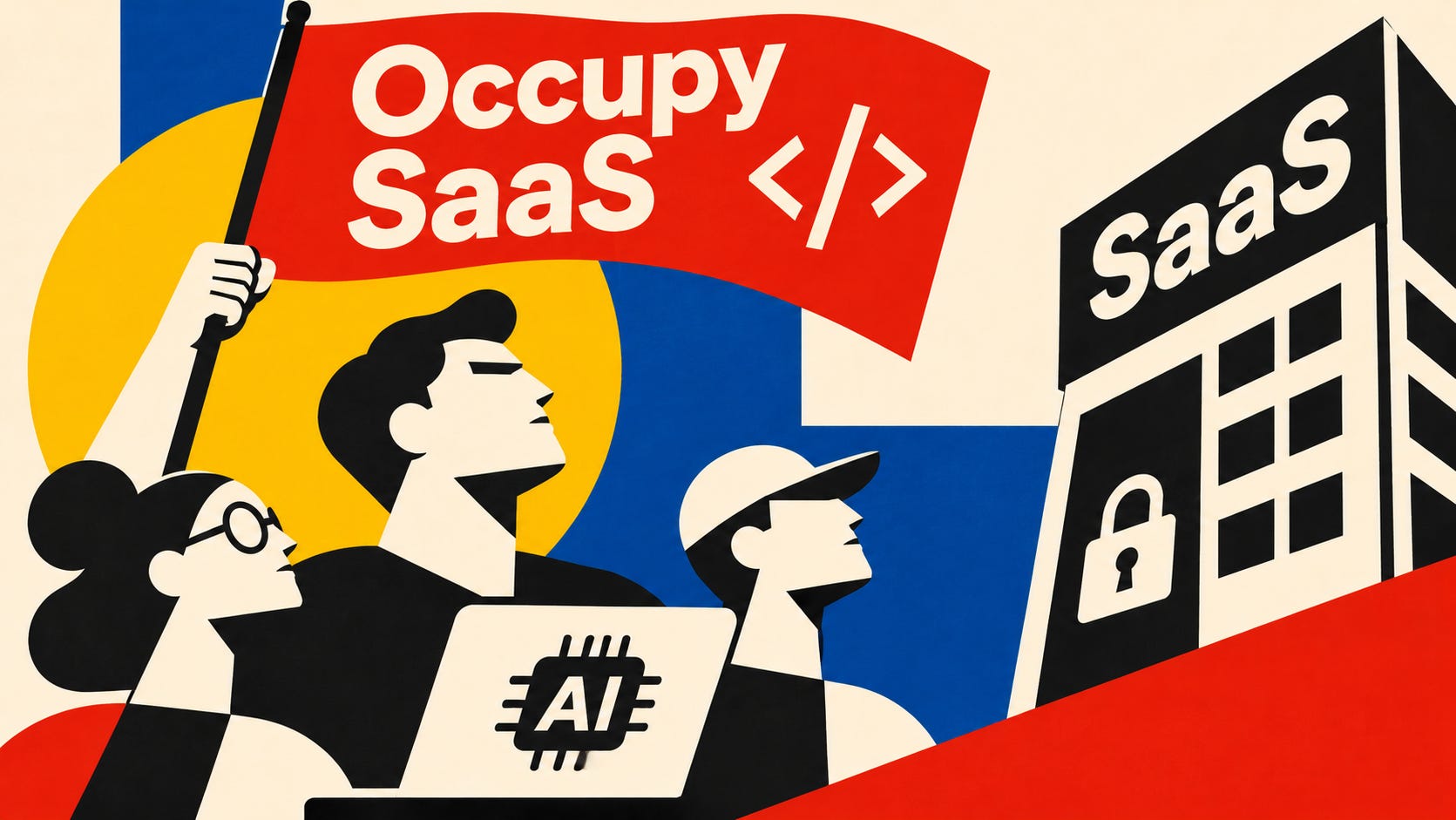
There’s something beautifully ironic happening in the software industry.
For years, technology companies have been explaining that artificial intelligence will make developers dramatically more productive. Then they started laying developers off.
Presumably, the plan was to replace expensive engineers with cheaper AI agents, improve margins, and continue charging customers increasingly ridiculous subscription fees.
A magnificent business strategy. Except somebody forgot one rather important detail.
The laid-off engineers can use AI too.
And now some of them have decided to use it to rebuild the very software platforms that made their former employers rich. For free.
Welcome to OccupySaaS. And I think this could become a rather interesting problem for the SaaS industry.
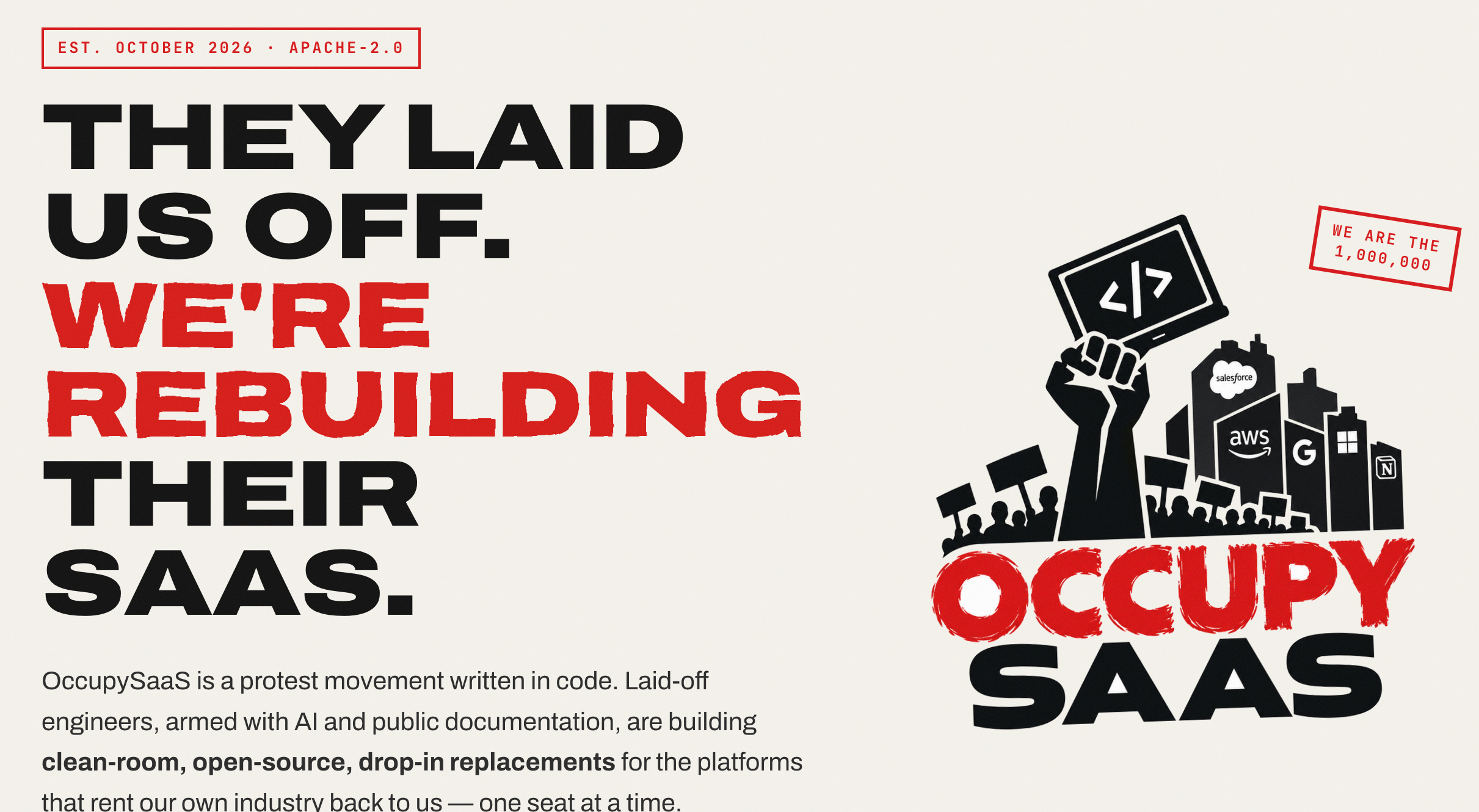
Occupy Wall Street, but with GitHub
Remember Occupy Wall Street? Back in 2011, people gathered in New York to protest economic inequality and the concentration of wealth.
Fifteen years later, OccupySaaS has borrowed the concept and updated the equipment. No tents. No megaphones. Just developers, AI coding agents, and a rather aggressive attitude toward recurring software subscriptions.
The movement describes itself as a protest written in code. The idea is straightforward.
Take popular commercial SaaS products, rebuild their functionality using public documentation, and release API-compatible, self-hostable alternatives under open-source licenses.
The important part is API compatibility.
Imagine your company uses an expensive authentication service. Normally, migrating away means rewriting integrations, changing application code, and potentially breaking something that has worked perfectly well for years.
OccupySaaS wants a different experience. Change the domain in your SDK configuration. Point it at your own server. Carry on working. No per-seat tax. No proprietary platform holding your application hostage.
At least, that’s the ambition. And it’s a rather appealing one.
First targets: Auth0 and Salesforce
The movement has released two early projects.
1. ZeroAuthy: The Auth0 alternative
ZeroAuthy is a self-hosted identity service written in Go. It aims to replicate the Auth0 Authentication API and supports technologies including OAuth 2.0, OpenID Connect, PKCE, JWT verification, and refresh tokens.
According to the developers, compatibility has been tested with several official Auth0 client SDKs.
Which means that, for supported operations, an application could potentially switch to ZeroAuthy without rewriting its authentication logic.
That’s clever. Authentication is a particularly interesting target because much of the underlying technology is already defined by open standards.
Of course, operating a secure identity provider is not the same thing as getting a login button to work.
Security, reliability, tenant isolation, recovery procedures, and ongoing maintenance all matter enormously. You don’t want to discover that your revolutionary free authentication service has accidentally authenticated the entire population of Belgium.
Still, the technical direction makes sense.
2. SalesCompel: The Salesforce alternative
Now this is considerably more ambitious.
SalesCompel attempts to recreate portions of Salesforce’s functionality using Go, PostgreSQL, Vue, and a REST API designed for compatibility testing. Its current capabilities include basic Account and Contact operations, limited queries, object descriptions, and external-ID upserts.
Which is a reasonable starting point. But replacing Salesforce is a bit like deciding to replace Heathrow Airport because you’ve successfully built a runway.
The runway is important. Unfortunately, there’s also the small matter of everything else.
Salesforce isn’t merely a database with a nice interface. It’s a gigantic ecosystem of integrations, custom objects, workflows, permissions, enterprise processes, reporting, consultants, and support arrangements.
Reproducing a few REST endpoints is comparatively straightforward. Reproducing twenty years of accumulated enterprise complexity is another matter entirely.
Both projects are experimental and explicitly not production-ready.
So perhaps don’t cancel your enterprise contracts tomorrow morning.
The clever part: AI as an industrial cloning machine
What makes OccupySaaS interesting isn’t simply that somebody is building open-source alternatives. We’ve had those for decades. It’s the proposed development process.
The projects follow a clean-room approach. Human contributors examine publicly available APIs, documentation, and standards. They turn that information into specifications.
AI agents then implement the functionality from those specifications, without accessing proprietary source code. And the completed implementations are tested against the original vendors’ public SDKs.
Essentially:
If the official SDK can’t tell the difference, the replacement is doing its job.
The developers also prohibit leaked source code, confidential information from former employers, decompiled software, and copied proprietary assets. All releases use the Apache 2.0 license. And Go was selected partly because it makes distributing self-contained server binaries relatively straightforward. It’s a sensible methodology.
Although clean-room procedures and compatibility claims still need to withstand independent technical and legal scrutiny. And, naturally, AI-generated code doesn’t become reliable simply because somebody has placed a beautifully written specification beside it. But the broader idea is compelling.
AI could dramatically reduce the cost of recreating software functionality that companies currently charge substantial premiums to access.
And that changes the economics of competition.
There’s just one rather awkward economic paradox
Here’s the part I find particularly fascinating.
Imagine OccupySaaS succeeds. Not necessarily against Salesforce immediately, but across smaller SaaS categories. Feature flags. Issue tracking. Observability. Documentation platforms. Customer support. All categories the movement has already identified as potential targets. Suppose AI-assisted open-source alternatives become sufficiently good that companies begin replacing expensive subscriptions.
Commercial SaaS revenue declines. Margins come under pressure. Management responds by reducing costs. Which, in the technology industry, frequently means laying off developers.
Those developers now have more free time. And better AI agents.
So they join the movement and build more open-source alternatives.
Which further reduces SaaS revenue.
Congratulations. We’ve invented a self-reinforcing software industry death spiral. The companies lay off engineers because of AI. The engineers use AI to undermine the companies. The companies lay off more engineers. And the cycle continues until the only remaining employee is a CFO desperately trying to cancel seventeen SaaS subscriptions.
Of course, that’s a deliberately exaggerated scenario. Open-source alternatives have existed alongside commercial software for decades, and enterprises continue paying for hosted services because reliability, security, support, integrations, and convenience have real economic value.
Running your own software isn’t free simply because the license costs nothing. Someone still has to operate it. And when your authentication service fails at three in the morning, the ability to blame somebody else’s support department suddenly becomes rather attractive. But the competitive pressure could still be significant.
Especially for SaaS products whose differentiation consists mainly of fairly standard functionality wrapped in a subscription model.
The moat is no longer necessarily the code
For years, software companies benefited from an important economic advantage. Building complex software was expensive.
You needed engineers, designers, infrastructure, testing, documentation, and years of accumulated experience. AI is starting to change the first part of that equation. Writing code is becoming cheaper.
Sometimes dramatically cheaper. But everything surrounding the code remains important.
Distribution. Trust. Operational reliability. Customer relationships. Integrations. Domain expertise. And the ability to maintain a product long after its enthusiastic creators have moved on to something else.
The real question is whether SaaS companies are selling software functionality or selling the assurance that somebody else will make that functionality work. Because the former is becoming much easier to reproduce.
The latter, not so much. And that’s why I find ZeroAuthy more immediately plausible than a complete Salesforce replacement.
Open standards and relatively well-defined APIs create opportunities for genuine interoperability.
An enormous enterprise platform with thousands of interconnected features is a much harder target.
My takeaway: The revolution might eat its own employers
It’s far too early to declare OccupySaaS a serious threat to the SaaS giants. Two experimental repositories and an entertaining manifesto do not constitute an industry revolution. And there’s no convincing evidence yet that the movement has achieved widespread adoption or production-grade compatibility. But I like what it represents.
The tools that make developers easier to replace also make those developers more capable of competing with established software companies.
That’s an interesting reversal. For a while, we’ve discussed AI almost exclusively as a source of power for large corporations. More automation. Fewer employees. Higher margins. But technology doesn’t necessarily respect the plans of the people financing it.
If capable AI coding agents become widely accessible, small teams may acquire development capabilities that once required entire engineering departments. And if those teams choose to build open alternatives to expensive commercial platforms, the effects could become substantial.
Not overnight. Not everywhere. But enough to make some SaaS executives rather uncomfortable.
The amusing thing is that the industry spent years telling developers that AI would make software engineering cheaper.
It apparently never occurred to anyone that cheaper software engineering might also make software cheaper.
And that, I suspect, is where things get interesting.
If this works, it will be revolutionary.
If it doesn’t work, lessons will be learned.