
Lean Vibe Coding
Why the fastest AI teams won’t win by writing more code — but by designing better flow, tighter feedback loops, and smaller bets


I think I’ve just stumbled into a useful term, so I’m claiming it here first:
Lean Vibe Coding
And the funny part is this: Toyota’s production system, lean manufacturing, Goldratt’s constraints thinking, DevOps, product thinking, and today’s vibe coding are all trying to solve the same problem.
Not “how to do more work.”
How to deliver value faster, and learn faster.
That’s the whole game.
Toyota’s magic was never just “the assembly line.” Everyone had assembly lines. The trick was building a system where value moved continuously and waste got burned out of the process. Problems didn’t hide until the final stage. They surfaced early. Constantly. Annoyingly.
Which is exactly why Toyota kept winning.
Not because they worked harder. Because they found mistakes sooner and fixed them sooner.
Small batches. Fast checks. Fast iterations.
Then that same logic moved into software.
That’s basically what DevOps is when you strip away the conference slides and tool worship. It’s not mainly about becoming a specialist in YAML gymnastics. It’s about reducing the size of changes, shipping more often, catching failures earlier, and making releases safer.
Build. Ship. Break. Learn. Fix. Repeat.
Continuous delivery is just Lean translated into code.
And then product management adds the part most teams try to skip: truth.
Because if you simply get faster at shipping features, but you don’t know how to test hypotheses, you’ve achieved something magnificent:
You are now producing nonsense at industrial scale.
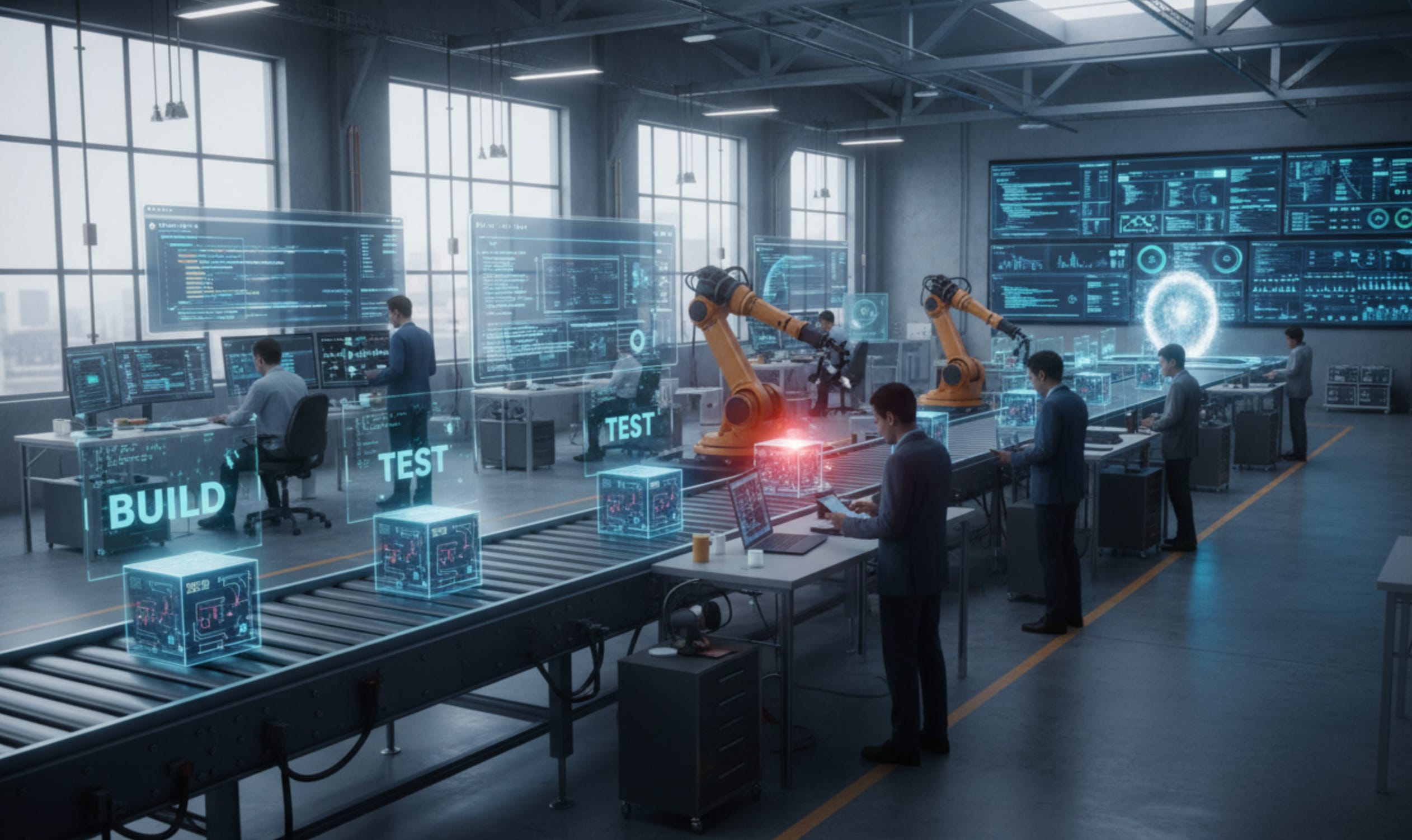
Product work matters because it forces the discipline:
hypothesis
metric
experiment
conclusion
Confirm fast or kill fast.
No romance. No ego. Numbers.
And now we arrive at vibe coding, which pours jet fuel on the entire loop.
A huge layer of work that used to take months and meaningful money can now be assembled in a couple of evenings. Not perfect, no. Often chaotic. Sometimes held together with prompts, duct tape, and blind optimism.
But usable.
Testable.
Close enough to a real product that the market can tell you the truth.
That is a very big deal.
Because the bottleneck is shifting. It’s no longer “can we build it at all?” nearly as often.
Now the bottleneck is:
do we understand the problem?
do we know what to test?
can we tell signal from noise?
can we improve the system faster than competitors?
In other words, vibe coding is not the opposite of Lean.
It’s Lean on steroids.
Same philosophy. Faster loop.
Which also means the old rules still apply:
Keep batches small.
Test early.
Don’t hide defects.
Don’t fall in love with output.
Optimize for learning, not for looking busy.
If you use AI to generate ten prototypes and test none, you are not being modern. You are just wasting tokens at high speed.
But if you use vibe coding to compress the cycle from idea to user feedback from three months to three days, then congratulations.
You’re not just coding.
You’re building a learning machine.
And that, in 2026, is about as close to a superpower as it gets.

P.S.
If you want one book that upgrades your thinking far beyond “DevOps jobs,” read The DevOps Handbook ((2nd Edition) by Gene Kim, Patrick Debois, John Willis, and Jez Humble (with Nicole Forsgren)).
Read it as a guide to IT and product management, not just infrastructure. It’s really a book about flow, feedback, and learning speed — which is exactly what this new era is about.