
Management Theory 2.0: When Everyone Becomes a Boss of Infinite Workers
AI didn’t just change how we write code. It’s quietly rewriting what a company is.


The modern company is turning into a machine that converts context (tokens) into actions. People won’t be replaced by “AI.” They’ll be replaced by teams who know how to run agents, curate context, and protect distribution. Processes won’t be “improved quarterly.” They’ll mutate daily. Your org chart will start looking less like HR and more like a data model.
I’ve had two offsites and two board meetings this week. Different industries, different stages, different founders… and somehow everyone ended up talking about the same thing.
Not “how do we use AI?”
That’s last year’s question.
This year’s question is: what even is a company now?
Because we’ve spent two years watching AI go from “a sometimes-helpful StackOverflow impersonator” to something far more annoying: an executor. A tireless one. The kind that doesn’t sleep, doesn’t eat, doesn’t get “burned out,” and costs about what you used to pay for Notion plus a mild sense of hope.
And yes, in the process it also sort of killed StackOverflow (or at least the business outcome of it), which is poetic in the same way it’s poetic when a meteor kills the dinosaurs and then starts selling dinosaur-shaped plushies.
But the real story isn’t coding. The real story is management.
We’re watching the birth of Management Theory 2.0.
1. Every employee becomes a manager of infinite labor
The old model:
You hire people to do work.
The new model:
You hire people to run a small army of agents that do work.
It’s not “AI replaces humans.” It’s “humans become the control layer.” Each strong individual contributor now has the leverage of a mini-firm, and the limiting factor becomes:
clarity of intent
task decomposition
evaluation
taste
and the unglamorous ability to keep the whole thing from turning into slop
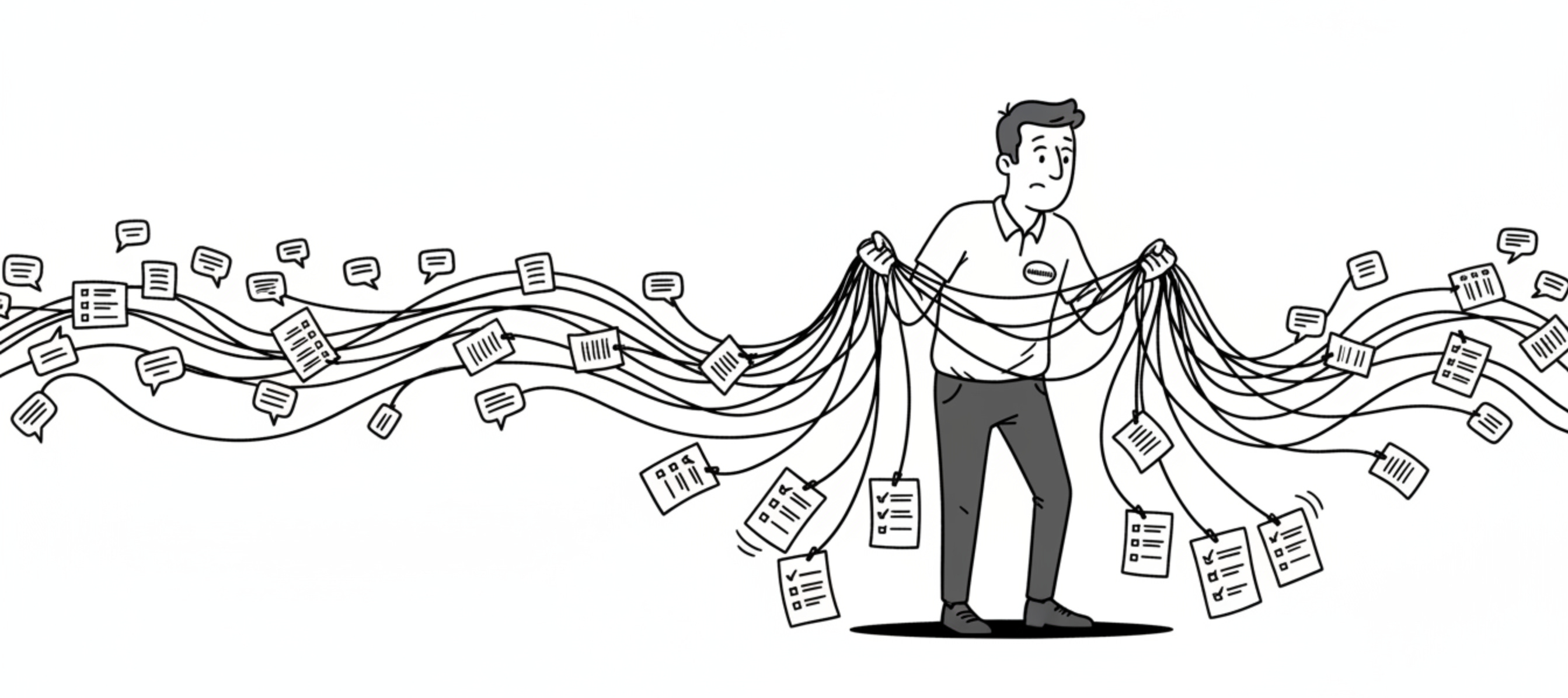
The job becomes less “do the task” and more “design the system that does the task repeatedly without embarrassing you.”
2. Context becomes the core asset
In a world where skills can be copied and pasted, what remains scarce is context:
customer history
product constraints
team conventions
domain nuance
relationships
decision logs
the “we tried that in 2023 and it blew up” archive
Agents and skills evolve at software speed. Your durable advantage becomes the graph of context that lets those agents do valuable work safely.
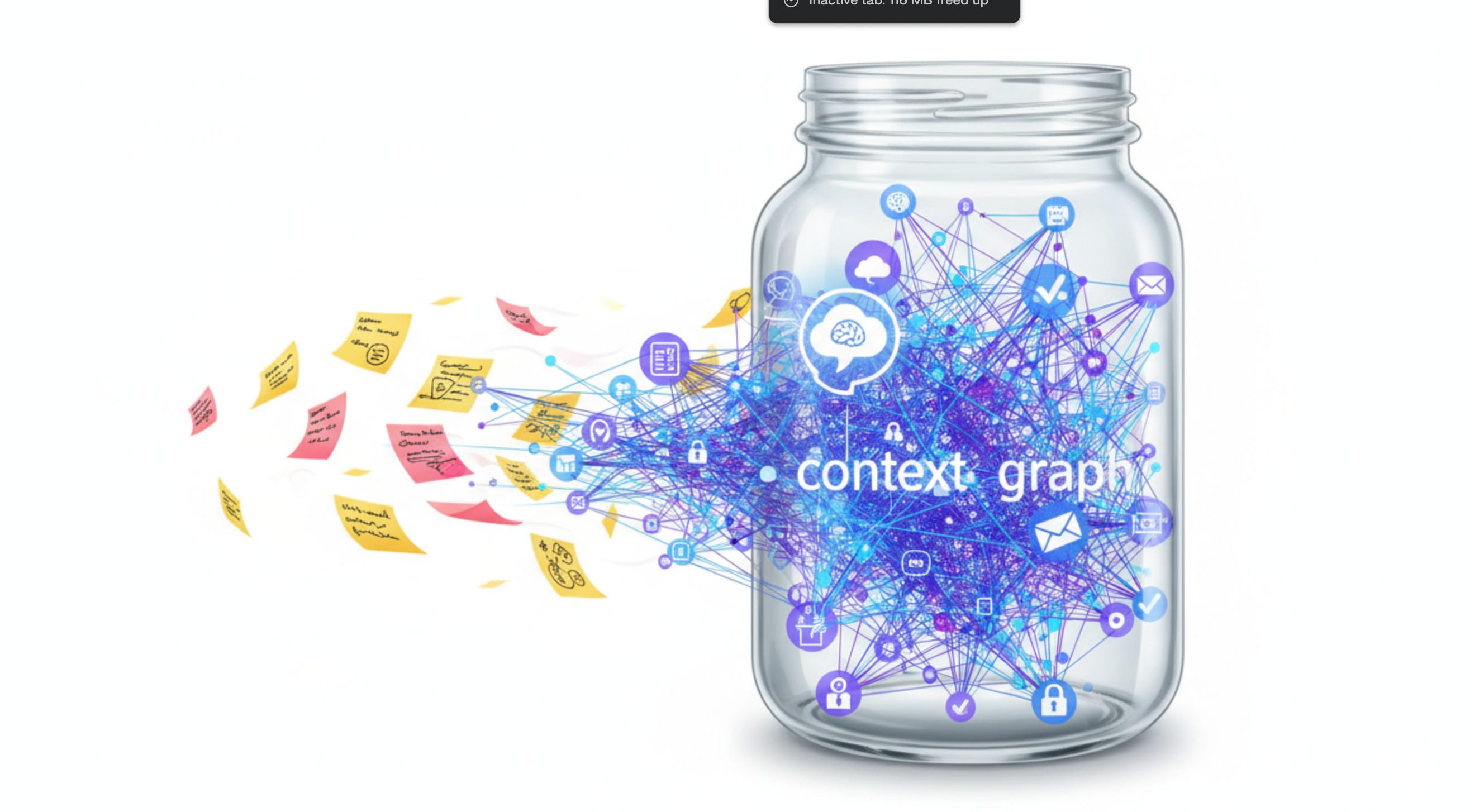
If you’re not building and curating that context, you’re basically feeding your company into a woodchipper one prompt at a time.
3. The org design shift: from process predictability to data predictability
Old companies tried to make processes predictable:
playbooks
approvals
meetings to schedule meetings
AI-native orgs flip it:
process is cheap, because agents can execute it. What matters is whether the data model is predictable:
What is a “customer” in our system?
What’s a “deal”?
What counts as “approved”?
Which fields are truth, which are guesses, which are vibes?
If your data model is mushy, your agents become confident liars at industrial scale.
So Management 2.0 looks suspiciously like… information architecture.
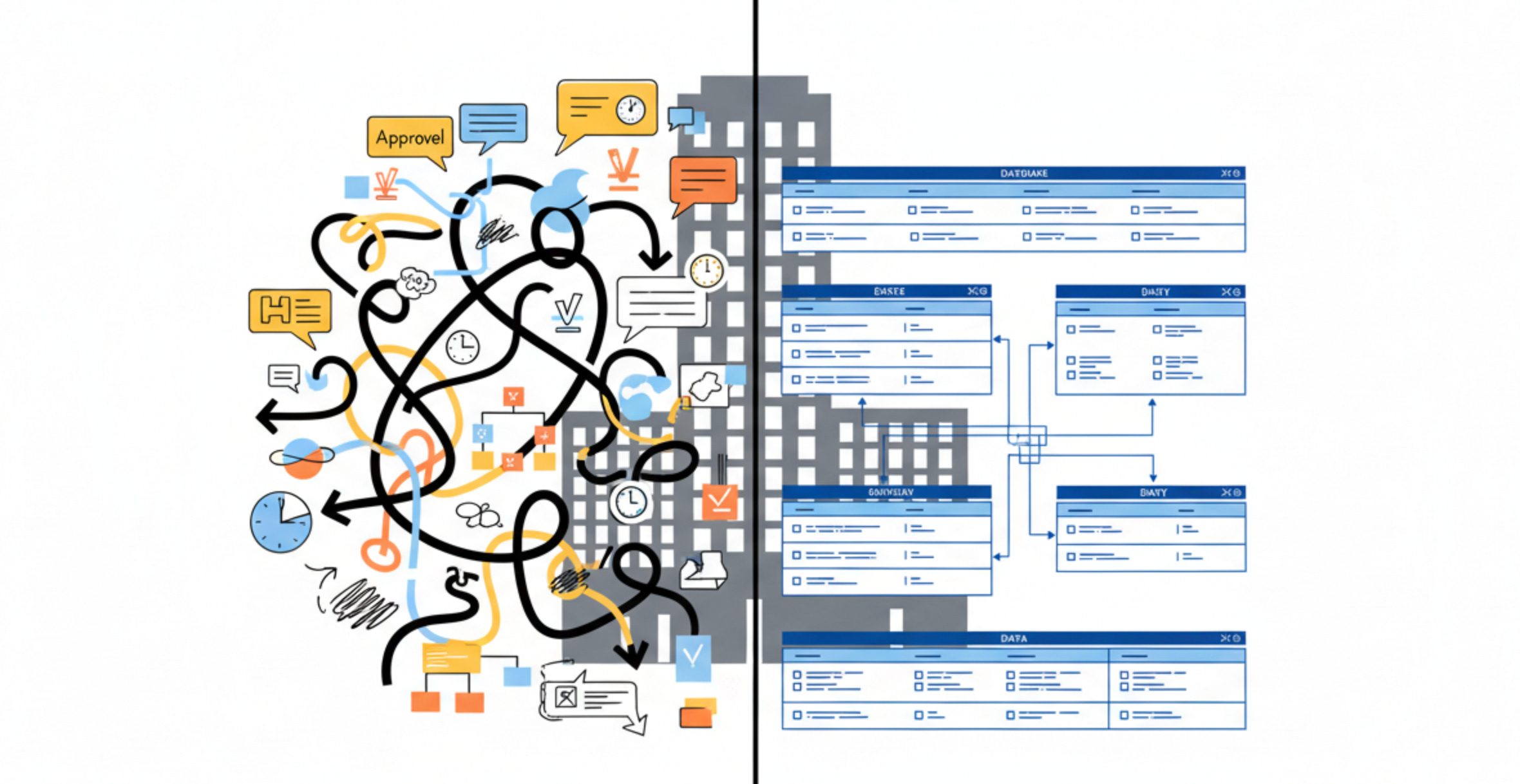
Which is hilarious, because half the world still treats “documentation” like it’s a medieval punishment.
4. Roles will disappear — and “AI champions” will appear everywhere
Some roles were essentially “translation layers”:
from messy reality → to structured output
from intent → to implementation
from “we should” → to “we did”
Agents eat that middle layer.
But what replaces it isn’t one central “Head of AI.” That’s a fantasy job title for companies that enjoy theatre.
The real winners will build AI champions inside every function:
a finance operator who can orchestrate agents, not just build spreadsheets
a lawyer who knows how to design contract workflows, not just review docs
a sales leader who can run automated research + outreach + follow-up pipelines
an ops person who treats processes like code
Deep domain expertise + agent leverage becomes the new seniority.
5. The company becomes a token-to-action pipe
Here’s the most useful mental model I’ve heard lately:
A company is no longer “people + processes.”
It becomes a pipe where:
tokens flow in (customer messages, market signals, feedback, competitor moves, internal decisions)
and actions flow out (commits, releases, contracts, invoices, shipments, escalations, negotiations)
Your competitive edge is:
what goes into the pipe (distribution and signal quality), and
what happens inside the pipe (context, orchestration, governance), and
how reliably actions come out (quality control)
This is why “we ship faster” stops being impressive. With enough agents, everyone can ship faster. You can scale “shipping” to infinity.
The hard part is scaling good decisions.
6. Distribution becomes the moat
When software is cheap to build, software stops being a moat.
Your moat becomes:
distribution
trust
brand
access
embedded workflows
relationships
switching costs created by cognitive/context effects
being the place customers already live
In other words: the old boring stuff. The stuff founders tried to ignore because it didn’t feel like “real tech.”
Congratulations. It’s real tech again.
7. Offsites won’t redesign processes quarterly. They’ll chase a system that changes overnight
In classic orgs:
you do an offsite
you “align”
you create a process
you roll it out
you forget it exists
you do another offsite to discover it’s broken
In AI-native orgs, the process graph can change constantly because:
the context graph updates continuously
the system learns new edges
new automations appear
old ones get replaced
and sometimes something quietly breaks at 2:13am and nobody knows why until the CFO asks why you negotiated a discount with a toaster
This means governance isn’t paperwork. It’s runtime.
So what do you do with this, tomorrow?
If you’re leading a team and you want to not get eaten by your own automation, here’s the practical checklist:
1) Start treating context like infrastructure
Make it structured. Maintain it. Version it. Audit it.
2) Build evaluation as a first-class system
If agents can do 10x output, you need 10x quality control.
Tests. Review gates. Sandboxes. Judges. Humans in the loop where it matters.
3) Promote AI champions inside each function
Not “AI team.” Actual operators who can run agent workflows in their domain.
4) Redesign around a clean data model
Define entities, states, ownership, permissions, and what “done” means.
5) Put distribution on the board agenda
Because it’s the only moat that doesn’t get copied in a weekend.

Closing thought
These are still scattered observations. But they rhyme. Hard.
We’re moving from “management as process” to management as systems design.
From “who does the work?” to “how does work reliably happen?”
From “company as people” to “company as a context engine.”
And yes: I’m working on turning this into a more closed theory, plus a reference implementation (internally I think of it as cybos — a “cybernetic operating system” for the org).
If you’ve already seen this shift inside your team — or you think it’s nonsense — tell me. The comment section is where the best signals show up.