
Music Is a Prediction Machine With Better Lighting
The brain likes music not because it is predictable, and not because it is chaos. It likes the little betrayal in between.
I spent some time torturing a scientific-paper search agent, then handed the gathered context to GPT-5.5 Pro with a simple question:
Why does music work on us?
The answer, after stripping away the neuroscience upholstery, is delightfully annoying:
The brain loves guessing what comes next.
Music is, in some sense, a lightweight prediction gym. Your brain listens to rhythm, melody, harmony, voice, bass, silence, repetition, texture, and tiny delays, and it is constantly making bets.
Here comes the beat.
Here comes the chorus.
Here comes the chord.
Surely now, you monster, resolve it.
And the pleasure is not produced by perfect predictability. That is a metronome, and nobody has ever heard one and said, “My God, this understands me.”
Nor is it produced by pure chaos. That is a kitchen falling down the stairs.
The sweet spot is somewhere between the two: you mostly understand where the song is going, but it keeps cheating just enough to remain alive.
This is close to one of the main theories in music cognition: musical pleasure depends on the relationship between expectation, surprise, and resolution. Research on musical reward prediction errors suggests that music can engage the reward system when what happens is meaningfully better, stranger, or more satisfying than expected. The same line of work shows that listeners tend to prefer music with intermediate predictive complexity rather than total simplicity or total disorder.
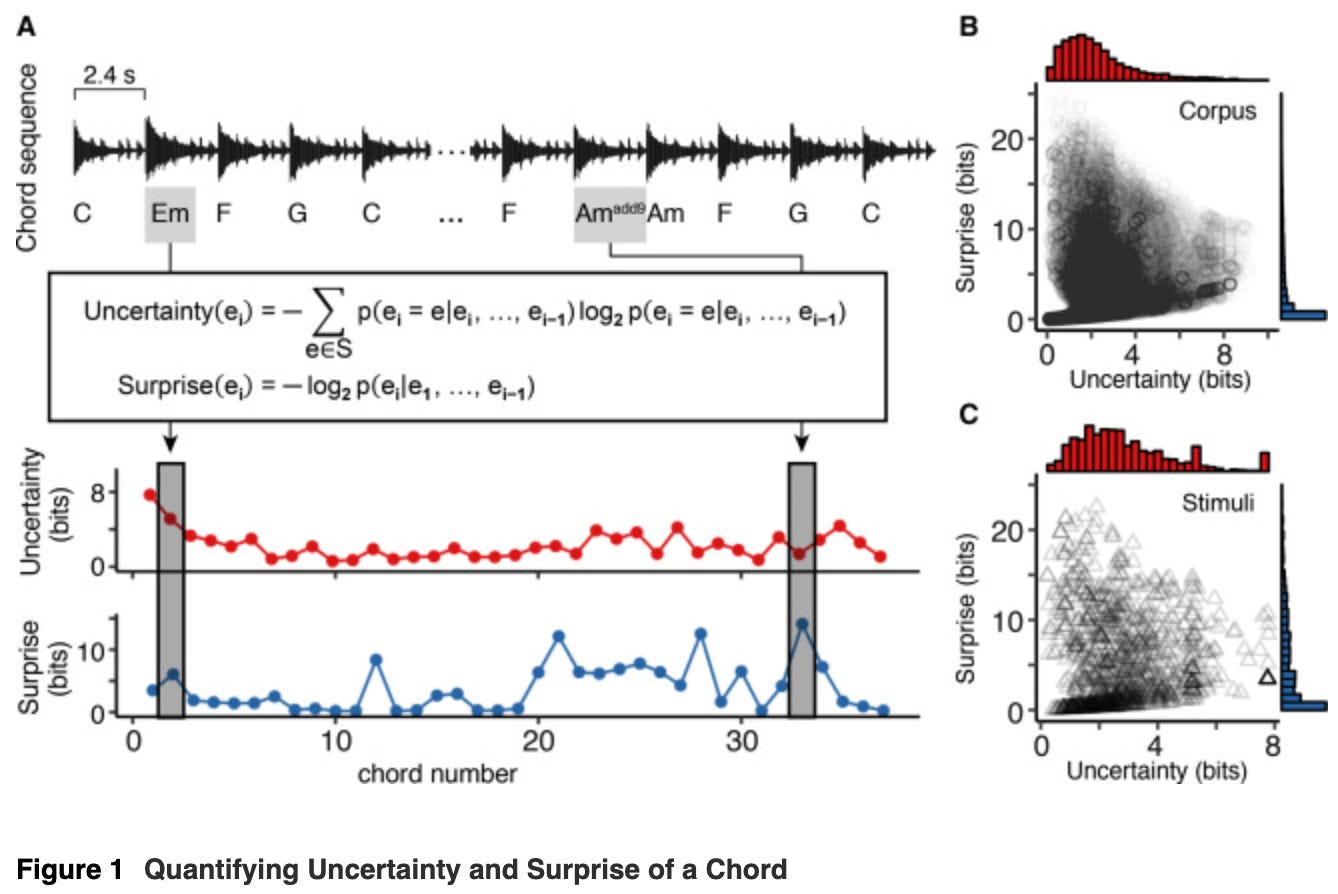
Think about the tiny pause before a chorus.
Nothing grand happens. The song just withholds the thing for half a second.
But the brain reacts as if someone has briefly seized control of reality and then returned it with a ribbon on it.
That is the trick. Good music creates tension, holds it, and releases it. A great track is not just a sequence of sounds. It is a small emotional story with timing precise enough to bully your nervous system.
This also explains why a beat drop is not really about the drop.
The drop works because of the wait before it. The producer has been holding you by the collar, tightening the spring, arranging the room, making promises in bass frequencies, and then finally lets the floor vanish.
The pleasure is in the forecast being violated, then resolved.
This is also why sad music can feel good. It gives the brain a safe version of grief. The emotion is real, but the catastrophe is not. You get melancholy without the administrative burden of actually ruining your life. There is a reason people will voluntarily listen to songs that sound like someone left their soul in a train station. The sadness is contained, shaped, aestheticized, and therefore usable.
And then there are chills.
Those strange little electric weather systems under the skin.
The neuroscience here is especially pleasing. A famous Nature Neuroscience study on dopamine and musical pleasure found dopamine release in the striatal system during intense pleasure from music, with anticipation and peak emotional response involving anatomically distinct reward areas. In blunt terms: the brain pays you for waiting, then pays you again when the moment lands.
This is why the best musical moments feel physical.
A note arrives. A harmony opens. A voice cracks at exactly the wrong-right time. The expected thing happens, but with one extra degree of human damage or beauty, and the brain sets off a tiny internal firework.
Of course, music is not just hearing.
That would be far too tidy.
Memory is involved. Movement is involved. The body is involved. Dopamine, associations, motor prediction, old rooms, bad decisions, school discos, summer nights, Kazantip, someone you loved, someone you should absolutely not have texted, all of it.
This is why the same song can be background noise for one person and a time machine for another.
The song is not only in the sound.
It is in the prediction system, the body, and the archive of your life.
An earworm, meanwhile, may be a tiny piece of music that has hacked the prediction machine too well: simple enough to repeat, unresolved enough to keep looping, annoying enough to make you briefly consider trepanation.
So yes, the current best answer seems to be: music works because it trains, teases, and rewards prediction.
It lets the brain rehearse expectation and surprise in a safe emotional sandbox.
Which brings us to the obviously dangerous future.
At some point, musicians will get accessible brain-response simulators, AI composition systems, coding agents, and tools like Meta’s TRIBE v2, a predictive foundation model trained on brain responses to sights, sounds, and language. Meta says TRIBE v2 was trained using data from more than 700 healthy volunteers exposed to media such as images, podcasts, videos, and text.
Now imagine pointing that kind of machinery at music.
Not “write me a song like Radiohead.”
Too crude.
More like: generate 10,000 variations of a hook, simulate expected brain response, optimize the pre-chorus delay, tune the harmonic ambiguity, personalize the unresolved loop, then deploy the version most likely to hijack the listener’s reward system without them noticing.
At that point, the musician becomes part composer, part neuroscientist, part dealer, part UX designer for dopamine.
Which is horrifying.
And, naturally, inevitable.
TL;DR: to be alive is to move through predictions.
Music works because it makes the next moment matter.