
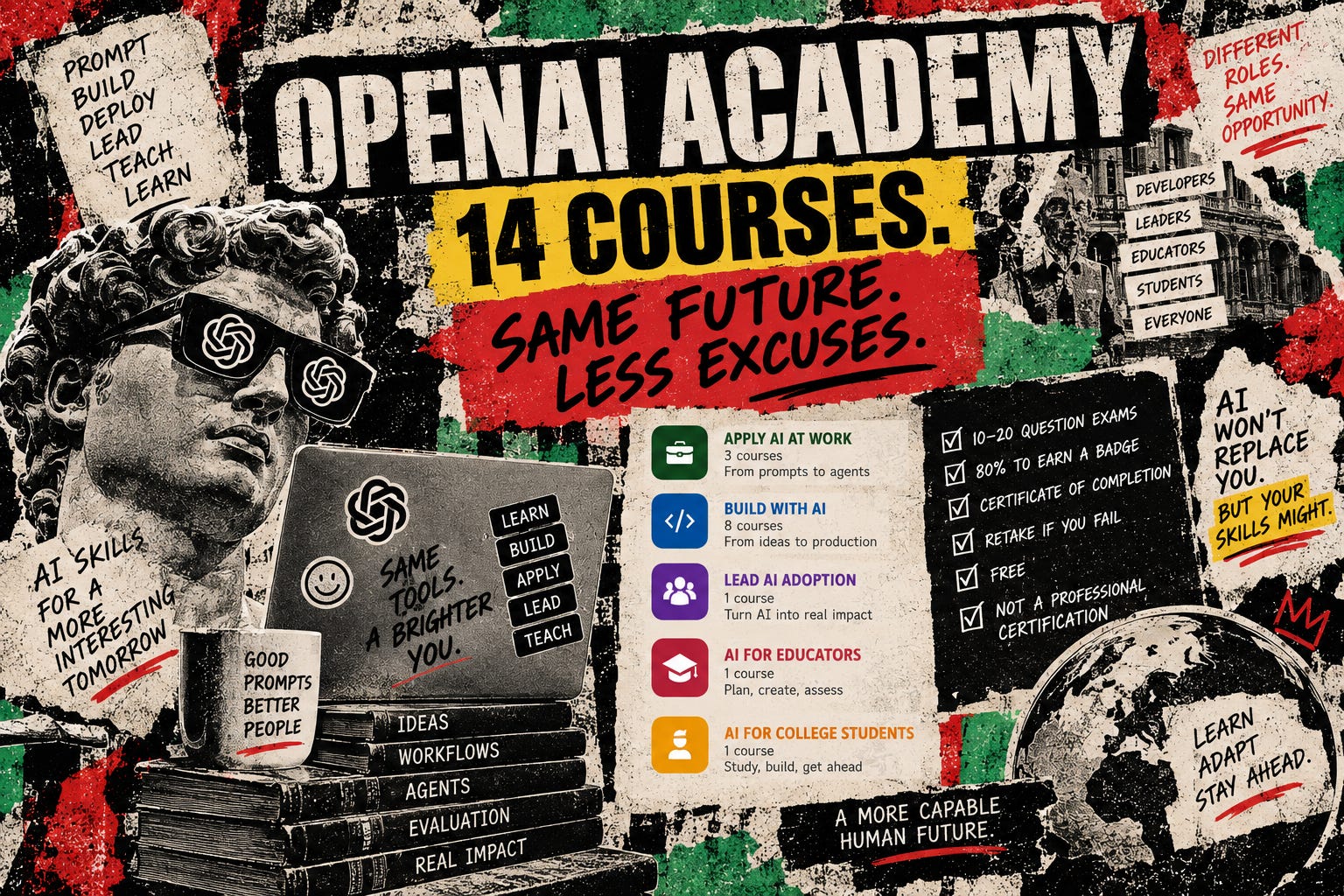
OpenAI just expanded OpenAI Academy into a fairly serious training platform. The catalog now contains 14 free, self-paced courses, organized around four broad roles: people using AI at work, developers building with AI, leaders responsible for adoption, and educators or college students. The new courses join the existing Apply AI at Work track.
At first glance this sounds like normal corporate education. Learn ChatGPT. Get badge. Put badge on LinkedIn. Fine. But I think the curriculum itself is a useful signal of how quickly the definition of “AI skills” is changing.
Two years ago, an introductory AI course was mostly about prompting. Now OpenAI’s beginner path ends with delegating work to agents, defining boundaries and inserting human checkpoints. The developer curriculum goes much further into evaluations, agentic systems, retrieval, production performance and Codex workflows. That is quite a shift.
AI literacy is becoming workflow literacy
The three-course Apply AI at Work track starts conventionally enough.
AI Foundations covers prompting, context, reviewing outputs and responsible use. Applied AI Foundations moves into repeatable workflows, breaking work into steps and deciding where review points belong.
Then Agents and Workflows teaches people to delegate structured work to agents while defining context, boundaries and checkpoints. This feels much closer to how competent AI use actually looks now.
The useful skill is no longer: Write a clever prompt.
It is increasingly: Give the system the right context, define the output, decide what should be delegated, specify where humans need to inspect the work, and turn the successful version into a reusable process.
That is a much better mental model. Prompt engineering survives, but it gets demoted from religion to component.
Developers get eight courses
The largest track is Build with AI, with eight courses split across OpenAI API work and Codex.
The API side covers:
scoping AI solutions;
evaluations and failure analysis;
agentic systems;
retrieval-augmented generation;
production optimization across quality, latency, reliability and cost.
The Codex side covers repository work, reviewing changes, reusable team workflows and eventually coordinating multiple workstreams under governance. Again, notice what is missing. Very little of this is “here is how an LLM works.” It is mostly how to make AI useful without letting the system become an expensive stochastic intern wandering around production.
Evaluations. Boundaries. Review. Governance. Operations.
In other words, the boring parts. Which usually means the field is maturing.
There is now a course for the people approving the budget
The Lead AI Adoption track currently consists of one three-hour course, AI Leadership. It asks leaders to take an actual AI initiative, connect it to business priorities, define ownership and governance, and build an initial strategy and roadmap. OpenAI This may be the most needed course in the catalog.
A lot of companies still have approximately this AI strategy:
CEO attends conference.
CEO discovers agents.
Every department gets instruction to “use more AI.”
Six months later nobody knows what success meant.
OpenAI’s version is at least trying to force the conversation toward specific initiatives, owners, measurement and adoption. Less inspirational keynote. More: who is responsible for this thing when it breaks? Progress.
Teachers and students get their own tracks too
There are also two education courses.
AI for Educators focuses on lesson planning, activities, assessments and communications, while explicitly keeping the educator responsible for checking results against learning goals and source material.
AI for College Students covers study planning, group projects, reviewing drafts against assignments, applications and interview preparation.
I like that these are framed around actual work rather than “10 magical prompts for students.” The common pattern across essentially all four tracks is the same: AI does more work. The human gets better at defining, evaluating and supervising it.
That seems increasingly like the job description.
Yes, there are exams
Every Academy course now has an assessment. The exams contain 10 to 20 questions, randomly drawn from a bank of 50. You need at least 80% to earn the corresponding OpenAI Academy badge, and if you fail you can retake it with a different randomized set of questions. You can also complete the course without taking the assessment. Badges are issued through Accredible.
Complete all courses and assessments in one of the eligible Foundations, Codex or API pathways and you can also receive a pathway certificate of completion.
Important small print: these are not professional certifications.
OpenAI explicitly distinguishes Academy badges and completion certificates from formal certification.
So perhaps wait before changing your LinkedIn headline to: Certified AGI Engineer
OpenAI is also packaging this for companies
There is already a fairly detailed deployment guide for organizations. It covers how to introduce the courses internally, get executive sponsors involved, assign paths to different employee groups, reinforce participation and track progress. OpenAI Academy. That makes the strategy fairly obvious.
Academy is not just a public learning library. OpenAI is building an adoption layer around its products. Teach employees ChatGPT workflows. Teach developers Codex and the API. Teach leaders how to organize deployment. Teach organizations how to roll the training out. Then update the courses as the products change. OpenAI says explicitly that the material will continue evolving with its models, products and guidance. Very sensible. Also a decent distribution strategy.
The curriculum may matter more than the badge
I would not overvalue the credential itself.
The useful part is the taxonomy. It tells us what one of the main AI companies now thinks people need to know. Not just prompts. Not even just ChatGPT.
The progression increasingly looks like this:
instructions → context → evaluation → repeatable workflows → agents → governance
For developers:
prototype → evals → agents → retrieval → production → multi-agent workflows
That is much closer to the way I think AI skills are actually evolving.
As models get better, less value sits in memorizing prompt rituals.
More value moves into knowing what to delegate, what context matters, what good output looks like, how to test it, and where a human still needs to intervene.
The model keeps getting easier to use. The judgment layer does not.
Which is probably why we now need 14 courses. OpenAI Academy is free and available globally to anyone with a ChatGPT account.