
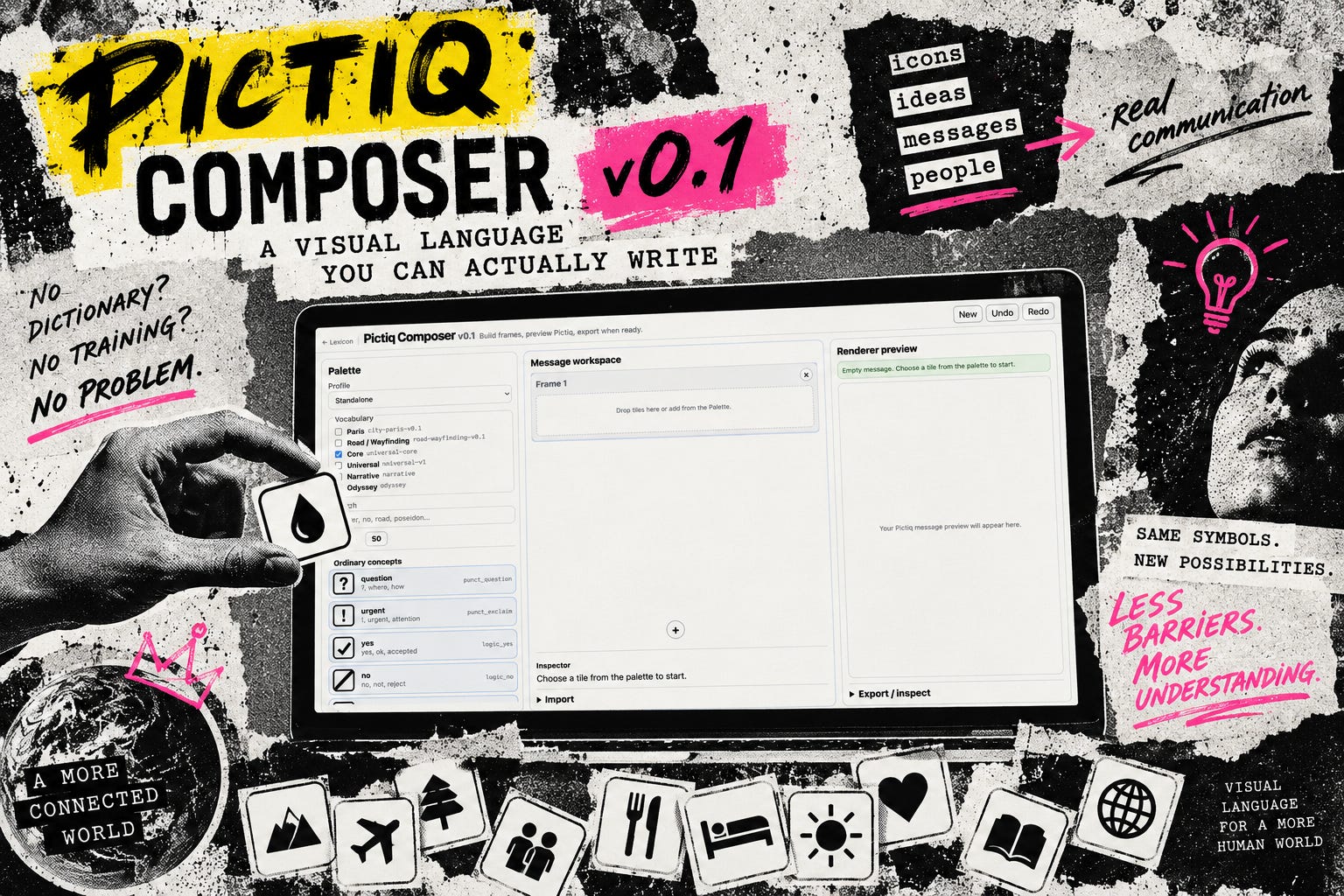
For most of its existence, Pictiq had a slightly embarrassing problem. It was supposed to be a visual language, but actually writing anything in it required knowing rather too much about GitHub, JSON, internal IDs and the machinery behind the language.
You could look at Pictiq. You could study it. I could produce messages with it. But that is not quite the same thing as having a language.
That has now changed. Pictiq Composer v0.1 is public.
You can open a palette of symbols, click them into a message, move them around, create frames, use contextual vocabularies and Entity Symbols, and immediately see the resulting Pictiq message.
No JSON required. No command line. No knowledge of how the repository works.

From icons to a system
This sounds like a UI update. It isn’t really. Pictiq began as a deliberately small collection of visual primitives. The interesting question was whether a limited vocabulary could avoid becoming a giant dictionary by relying on composition and context instead. That eventually created another problem.
If Pictiq messages have structure, there needs to be a canonical way to represent that structure.
So the project gradually acquired a machine-readable Message Format, a shorthand notation, validation, Entity Symbols, numeric notation and a deterministic Renderer.
The whole project, including the language specification, vocabulary, Renderer, research notes and Composer, is open on GitHub.
The Composer sits on top of all of this rather than replacing it.
What you arrange visually is still a canonical Pictiq message. The preview comes from the same rendering architecture. You can export the result as structured JSON, Pictiq shorthand or SVG.
There are even two Renderer implementations, Python and browser-side JavaScript, with automated parity tests to make sure the language does not quietly become two different languages depending on where it is rendered. All of which is wonderfully excessive engineering for arranging a few little pictures on a screen. But it also means we can finally start asking more interesting questions.
A language you shouldn’t have to learn first
One of the ideas that has become clearer while building Pictiq is that I don’t particularly want people to learn Pictiq. At least not before they can use it.
The stronger hypothesis is what I now call zero-training entry.
Imagine two people who share no spoken language. Put a collection of reasonably recognizable symbols between them. One person selects a few symbols and arranges them. The other looks at the result.
Can useful communication begin before either person knows that the system is called Pictiq, has read its grammar or memorized its vocabulary? That is a much harder requirement than making a language easy to learn. And it is still only a hypothesis.
The Composer matters because it gives us somewhere to start breaking it.
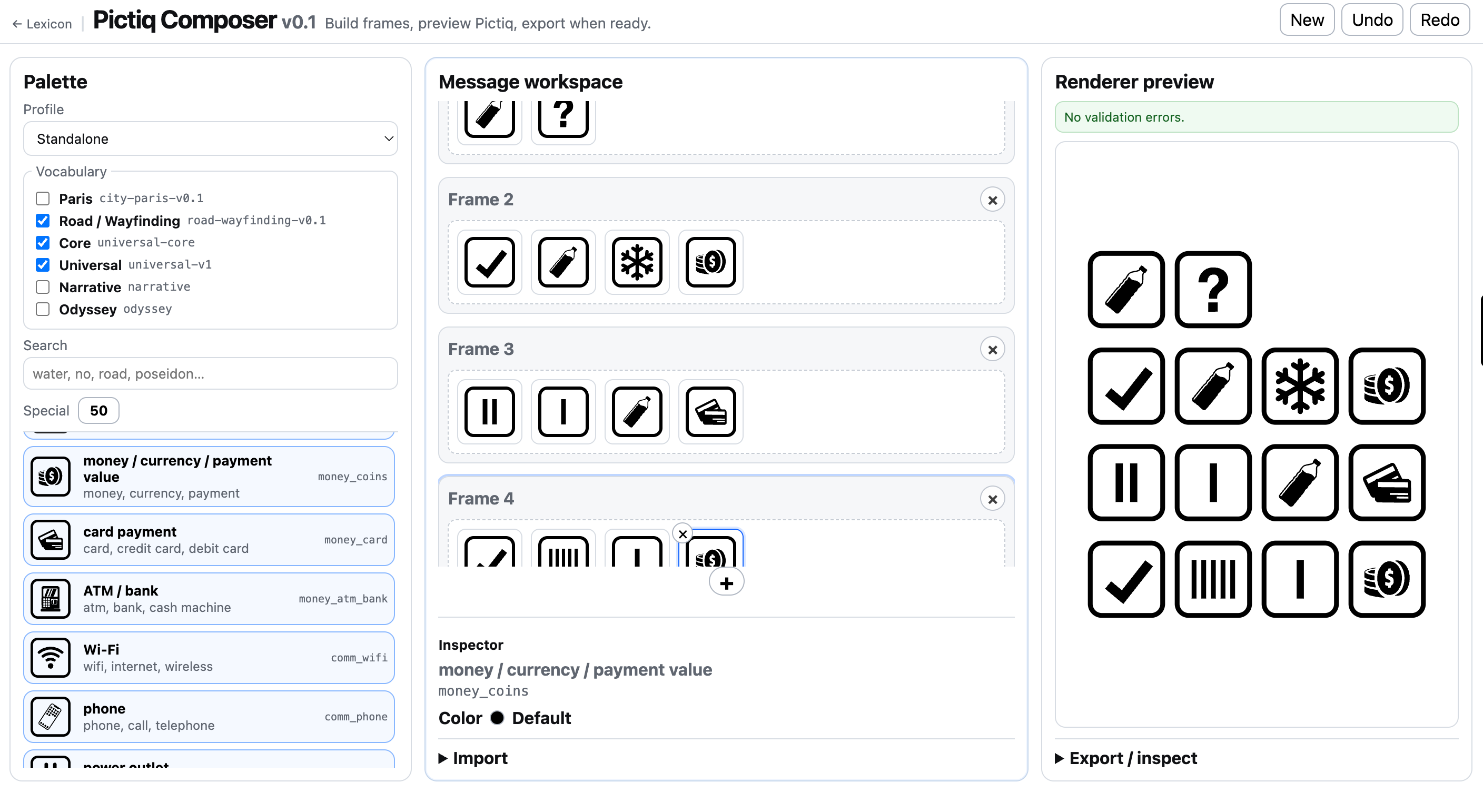
My intended dialogue was:
- “Do you have water?”
- “Yes. We have cold water for sale.”
- “Three bottles, please. Do you take cards?”
- “Yes. That will be six units of local currency.”
Deliberately no AI
There is also something conspicuously missing from Composer v0.1.
There is no box saying: Describe what you want to say. There is no LLM translating English into Pictiq for you. That would have been relatively easy to add, but it would also make the experiment considerably less interesting.
Before asking an AI to compose the language, I want a clean human-authoring layer. Later we can compare human compositions with AI compositions, show previously unseen Pictiq messages to different multimodal models, and see whether any of them independently arrive at similar interpretations.
If an LLM has to explain Pictiq to everybody, then Pictiq itself has failed a rather important part of the assignment.
Now we can misuse it properly
The next phase is less about adding features and more about putting the system in places where it may or may not belong.
Software interfaces. Travel. Children’s picture books. Comics. Logistics. AI actions. Physical communication cards. Perhaps even games in which people have to communicate using a constrained hand of Pictiq symbols.
Some of these will probably work. Some will probably expose missing concepts or bad assumptions. Some may turn out to be completely pointless. That is the useful part.
Pictiq now has a vocabulary, a representation format, a Renderer and an authoring tool. It is finally becoming possible to stop explaining why a tiny visual language might work and start watching what happens when we actually try to use one.
The Composer is public now. Try saying something with it.
Or start with the dialogue above: before reading my translation, what did you think it said?