
Posting on LinkedIn Is Cringe. Burning $300K on Leads Is Worse.
Why founders should stop treating social distribution as embarrassing and start treating it as one of the cheapest GTM channels they own.
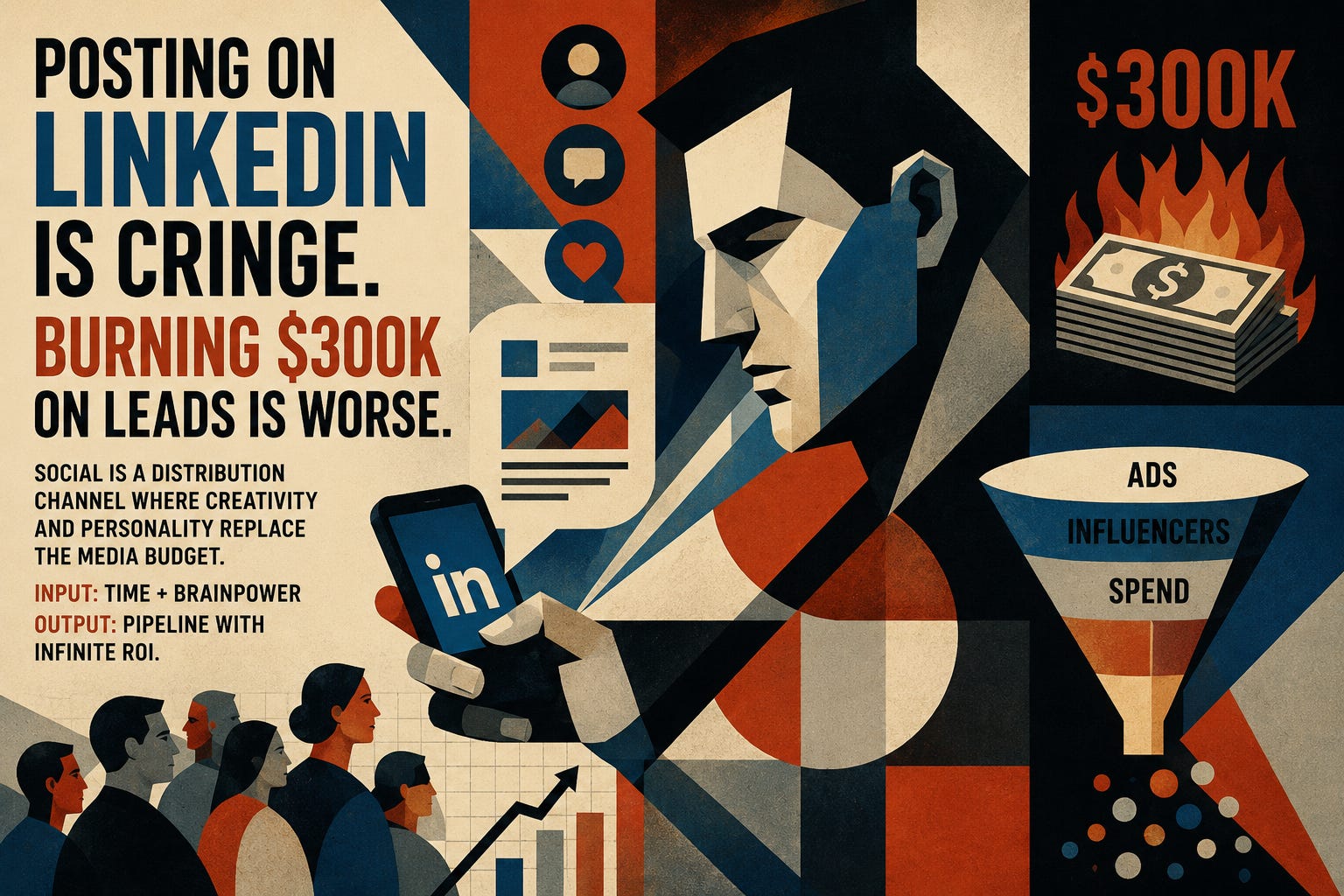
There is a very serious disease among founders and growth teams.
It is called: “We do not want to look cringe on the internet.”
Symptoms include: whispering the phrase “personal brand” as if it were a skin condition, spending six months polishing a landing page nobody visits, and then handing $300,000 to ad platforms because apparently that feels more dignified.
A useful story came from Davide Grieco, Head of Growth at Clay. He wrote a LinkedIn post promoting a livestream about how Clay runs marketing and growth. Not a polished cinematic campaign. Not a $200,000 influencer activation. Not a twelve-step omnichannel demand generation ritual performed under a full moon.
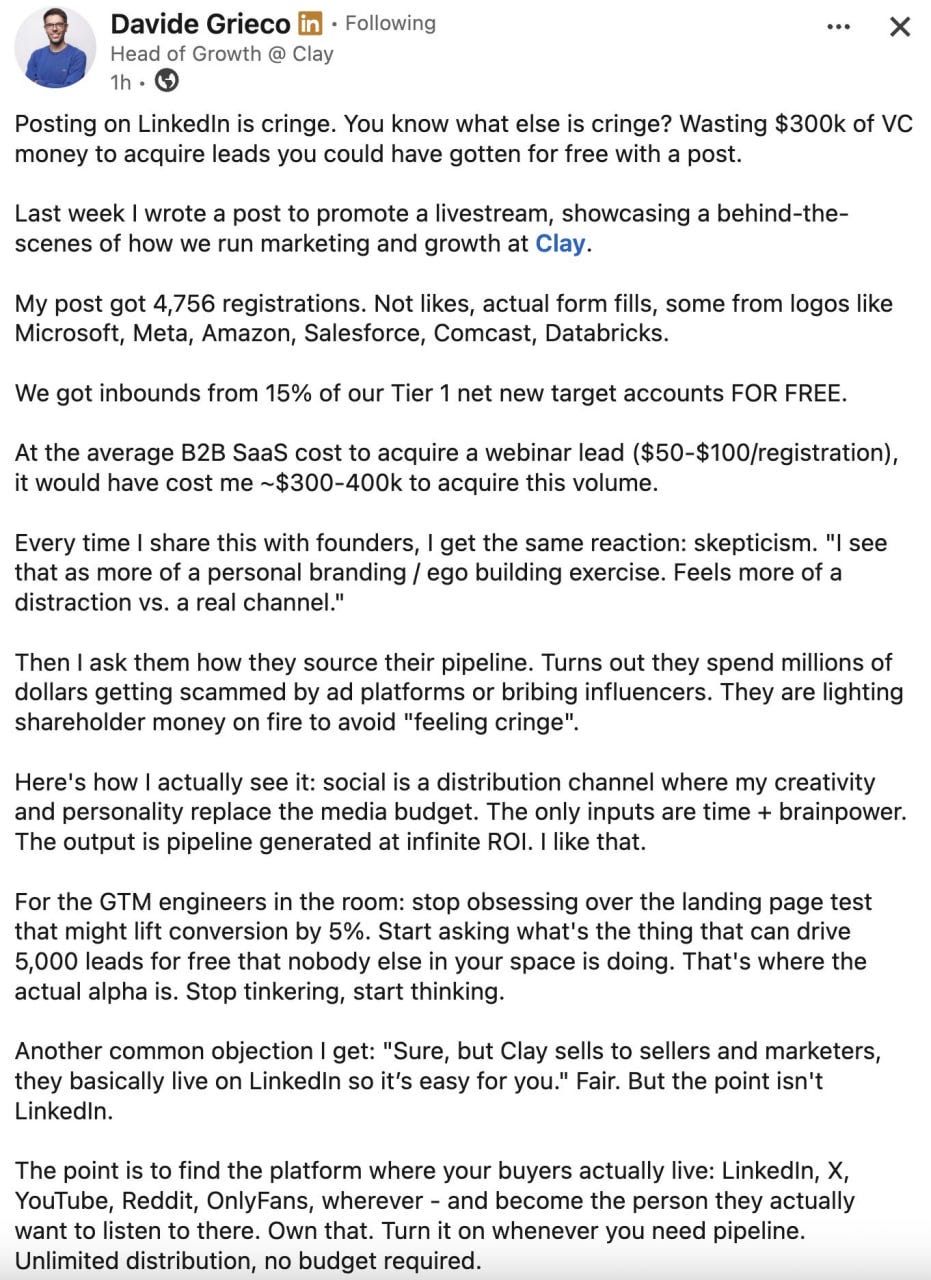
A post. The result: 4,756 registrations. Not likes. Not impressions. Not “engagement,” that soft little marshmallow word marketers use when nothing commercially useful happened. Actual form fills.
Some came from companies like Microsoft, Meta, Amazon, Salesforce, Comcast, and Databricks. Clay also got inbound interest from 15% of their Tier 1 net-new target accounts. For free.
At a typical B2B SaaS webinar lead cost of $50 to $100 per registration, that volume would have cost roughly $300,000 to $400,000 to acquire through paid channels. This is the bit where the spreadsheet quietly walks into the room and hits the brand team with a chair.
Because the usual objection is always the same.
“Posting feels cringe.”
“It looks like personal branding.”
“It feels like ego.”
“It does not seem like a real sales channel.”
Fine. But then you ask where the pipeline comes from. And suddenly the answer is: paid ads, sponsored placements, influencer deals, cold outbound machinery, agency retainers, and a collection of acquisition tactics that somehow feel very professional because the invoice is large. This is one of the strangest features of modern B2B.
A founder posting useful ideas where buyers actually spend time is considered embarrassing. But burning venture capital on ads nobody wants to see is called strategy. Lovely.
The point is not that everyone should become a LinkedIn guru. Please, no. The world has suffered enough.
The point is that social distribution is a real channel when the right person says something useful to the right audience in the right place. Not because “content is king,” which is the sort of phrase that should be locked in a basement with “thought leadership” and “synergy.” But because attention is expensive.
Trust is expensive. Qualified demand is expensive. And if you can generate those things with time, taste, and a point of view instead of a media budget, then pretending it is not a real channel is not strategic discipline. It is vanity in a Patagonia vest.
The mistake many teams make is treating content as decoration.
Something for awareness. Something for brand. Something the marketing intern does after updating the case study page. But in the right market, content is not decoration. It is distribution infrastructure.
A good post can test a message. A good post can surface demand. A good post can reach buyers before sales knows they exist. A good post can turn a person into a channel. And, unlike most paid acquisition, it compounds.
A paid campaign ends when the budget ends. A strong operator with an audience can turn the channel back on whenever they have something worth saying.
That is not “ego.” That is owned distribution. Of course, there is a fair objection.
Clay sells to sales and marketing teams. Those people practically live on LinkedIn. They wake up, brush their teeth, check pipeline, and post about pipeline.
So yes, LinkedIn is especially natural for Clay. But that does not weaken the lesson. It sharpens it.
The point is not LinkedIn. The point is buyer habitat.
If your buyers live on LinkedIn, be there. If they live on X, be there. If they live on YouTube, be there. If they live on Reddit, be there carefully, because Reddit can smell marketing through concrete. If they live in Discord, GitHub, niche newsletters, podcasts, Telegram groups, private Slack communities, industry forums, conferences, or some horrifying corner of the internet nobody wants to explain to finance, be there.
Your job is not to post everywhere. Your job is to become worth listening to somewhere that matters. This is where many GTM teams get it backwards.
They obsess over tiny mechanical improvements: A landing page test that might lift conversion by 5%. A button colour. A new headline. A better lead magnet. A drip sequence with slightly less soul damage. All useful, perhaps. But none of it matters much if nobody cares enough to arrive in the first place.
The higher-leverage question is:
What could bring 5,000 qualified people into our orbit for almost no marginal cost?
What can we say, show, teach, reveal, or explain that nobody else in our category is willing or able to do?
What do we know that our buyers would actually stop scrolling for?
That is where the alpha is. Not in pretending content is beneath you. Not in outsourcing taste to an agency. Not in paying increasingly absurd CPMs because the team is too scared to sound human in public. The new GTM advantage is not merely having a better funnel. It is having a distribution surface your competitors cannot rent.
A founder with taste. A growth leader with proof. A technical expert who can explain the market. A product builder who shows the real work. A company that becomes the most useful voice in its category.
Yes, posting may feel cringe. But spending $300,000 to avoid feeling cringe is worse.