
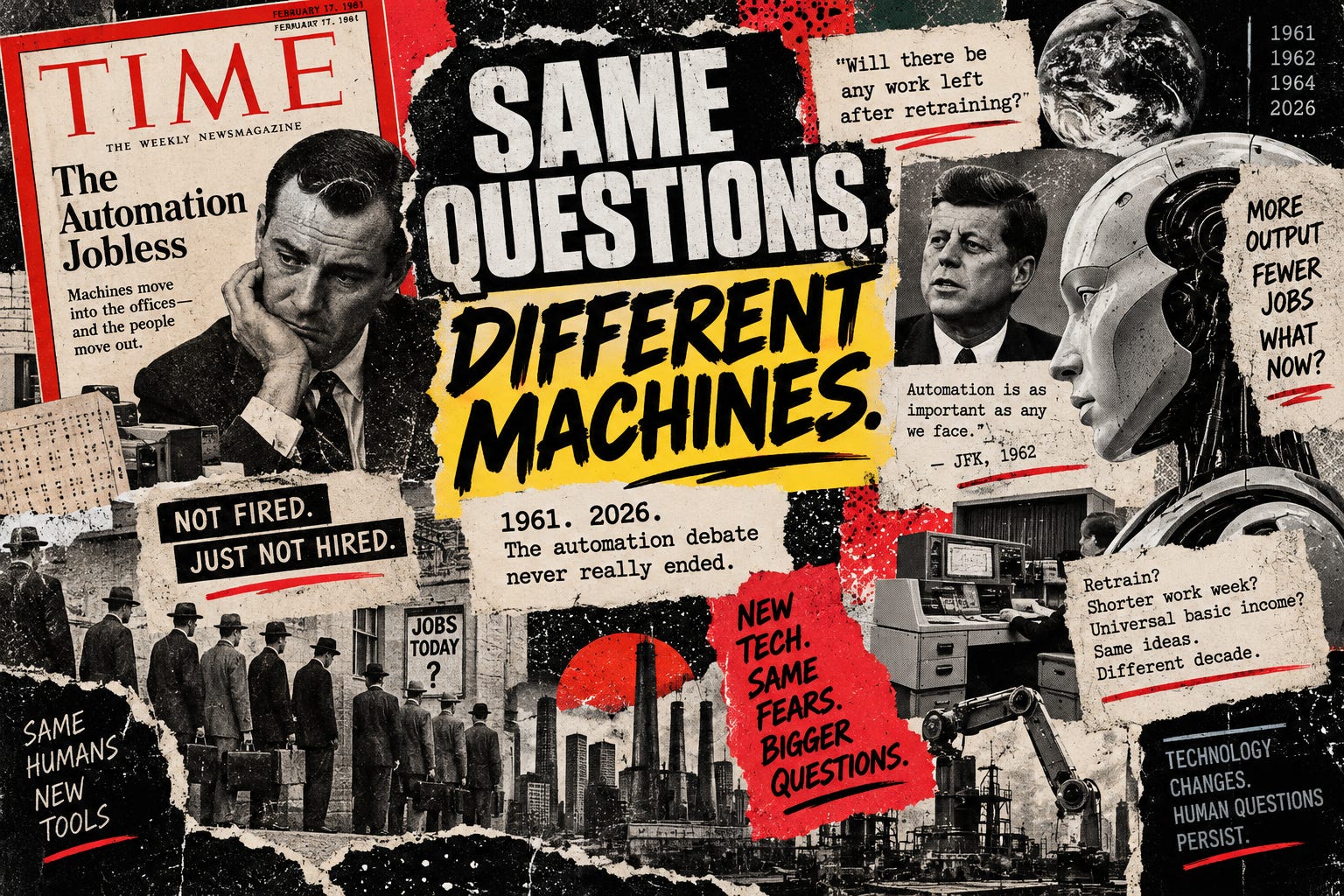
Sixty-five years ago, America was already asking whether machines would produce more with fewer workers, destroy entry-level jobs, make retraining pointless, and eventually break the link between work and income. They got the company-level economics mostly right. They got the economy wrong.
One of my readers sent me something wonderful: a TIME article about AI and the labor market in 2026.
There was only one problem. It was published in 1961.
The article was called The Automation Jobless, and if you replace “automation” with “AI” in a surprising number of paragraphs, it could have been published last Tuesday.
Its central concern was painfully familiar: companies were learning to produce more while employing fewer people, and technological progress might no longer create enough new jobs to compensate for the ones it eliminated.
TIME even had the perfect description of the emerging labor market: “Not Fired, Just Not Hired.” That sounds rather familiar in 2026.
27% More Output, 3% Fewer Workers
The numbers looked frightening. In the highly automated chemical industry, production had risen 27% since 1956 while production employment fell 3%.
Steel capacity had increased 20%, while the number of workers required to operate the plants had fallen by 17,000. And automation was already escaping the factory and entering the office.
The U.S. Census Bureau had required 4,100 statisticians to perform census tabulations in 1950.
Ten years later? 50 people.
Banks were installing machines that could process checks and paperwork, and expected to expand their businesses enormously without substantially expanding their staff.
The Bell System had increased call volume by 50% over a decade while employment rose only 10%.
If you were looking at those numbers in 1961, the conclusion seemed obvious. Productivity was separating from employment. Machines weren’t merely helping workers anymore. They were beginning to replace them.
And Then the Government Noticed
By January 1962, the issue had reached the White House. John F. Kennedy called automation “as important as any we face.”
The policy recommendations sound remarkably contemporary: retraining displaced workers, financial support during unemployment, better employment services, public investment, tax measures to stimulate employment and even possible reductions in working hours.
Kennedy’s administration also backed the Manpower Development and Training Act, explicitly framing technological change as a cause of long-term unemployment that government needed to address.
Again: 1962. No ChatGPT. No Claude. No coding agents.
Computers were still enormous boxes that made less noise on Twitter because Twitter wouldn’t exist for another 44 years. And people were already discussing retraining, technological unemployment and shorter working weeks.
Then Came the Singularity People
In 1964, things became even more interesting. A group of intellectuals, economists, activists and technologists sent President Lyndon Johnson a manifesto called The Triple Revolution.
Its first revolution was “cybernation”: computers combined with automated, self-regulating machines. The authors argued that this new system could create almost unlimited productive capacity while requiring progressively less human labor. They believed technological change was advancing faster than existing social institutions could adapt.
Sound familiar yet? Their argument went further.
If production increasingly stopped requiring human labor, then the traditional relationship between having a job and receiving an income would eventually stop making sense.
The manifesto moved toward guaranteed income and toward a society where producing goods and services would no longer necessarily be the primary mechanism for distributing income.
Replace cybernation with AI, clean up the 1960s political vocabulary, and substantial chunks of the argument would fit comfortably into a 2026 Substack post about AGI and UBI. And yet here we are.
They Were Right About Companies
This is the important part. The automation pessimists weren’t stupid. In fact, they understood the microeconomics remarkably well.
Automation really did allow companies to produce much more with fewer workers. Entire occupations disappeared. Industries radically reduced the amount of labor required per unit of output.
TIME returned to the subject at the end of 1961 and described oil operations where three people could do work that previously required twelve. At the same time, however, manufacturing was employing 13% more clerical workers and 65% more professional and technical workers than in 1952. That’s where extrapolation became difficult.
They could see exactly which jobs the new machines were destroying. They couldn’t see all the jobs, products, industries and demand that cheaper production would eventually create. Neither can we.
100 People Doing the Work of 1,000 Doesn’t Mean We Need 90% Fewer People
This is probably the historical lesson I find most useful for today’s AI debate. Suppose AI allows 100 people to produce what previously required 1,000. That’s an enormous change. But it does not automatically follow that the economy now needs 900 fewer humans.
Maybe the company produces ten times more. Maybe prices collapse and demand explodes. Maybe hundreds of new companies become economically viable. Maybe entirely new products appear. Maybe labor moves somewhere nobody currently thinks of as an industry.
We are reasonably good at imagining substitution. We are terrible at imagining induced demand and entirely new categories of economic activity.
A pager operator in 1995 could understand perfectly well that mobile phones might destroy pager jobs.
Ask them to forecast the employment market created by TikTok influencers, Shopify stores, cloud infrastructure, podcast production, app-store optimization, cybersecurity, YouTube thumbnails and performance marketing.
Good luck. The future doesn’t merely replace jobs. It invents weird new reasons to employ people.
But AI Might Actually Be Different
And here’s where the comforting historical analogy stops being comforting.
AI isn’t a textile machine. It isn’t a spreadsheet. It isn’t even a conventional computer. It’s unusually general.
The same underlying technology can write code, design products, analyze contracts, diagnose images, produce advertising, tutor students, conduct research, operate software and increasingly control machines.
Most previous automation replaced specific classes of tasks. AI is beginning to automate something closer to the general machinery humans use to perform intellectual work: language, reasoning, creativity, planning and decision-making.
Add robotics and the loop gets stranger. AI systems perform intellectual labor. That labor helps design better AI systems. AI designs better robots.
Robots manufacture things, build factories and eventually help extract and process the resources required to manufacture more robots.
At some point, that loop could become qualitatively different from previous automation.
I’m not dismissing that possibility at all.
I Just Don’t Think It Happens by Tuesday
Where I become skeptical is the timeline.
We repeatedly jump from: “AI can perform an astonishing amount of economically useful work.”
to: “Therefore the labor economy disappears within five years.”
Those aren’t the same claim.
Even if the destination is a deeply automated economy, getting there requires absurd amounts of physical and institutional work. Data centers. Power plants. Transmission. Factories. Robotics. Supply chains. Capital. Regulation. Deployment. Integration into millions of companies. Redesigning organizations around completely different cost structures. And, ironically, enormous amounts of human labor to make all of that happen.
Even the machine economy needs someone to build the machine economy. At least at first.
History Doesn’t Tell Us AI Won’t Kill Jobs
It tells us something subtler. People in 1961 were right that automation was transformative. They were right that individual companies could dramatically increase output without proportional increases in employment. They were right that some workers would be displaced. They were right that skills would become obsolete. They were right that society would struggle to adapt.
What they couldn’t reliably predict was the second-order economy created by the productivity revolution itself. That’s the part we should be humble about today.
Maybe AI really is the technological discontinuity that finally breaks the historical pattern. Maybe sufficiently capable AI plus robotics eventually makes most human labor economically unnecessary. I consider that a serious possibility. But history gives us a useful warning against jumping directly from a productivity graph to the end of work.
We’ve made that jump before. Repeatedly. And the wonderfully ironic part is that while the machines kept taking our jobs, humanity somehow kept inventing increasingly bizarre new ones.
Perhaps this time really is different. But before declaring the death of work in 2031, I’d like to see what people invent once intelligence itself becomes 100 times cheaper.
Because if history has taught us anything, it’s that we’re much better at predicting which jobs technology destroys than imagining what humans will do with abundance afterward.
How do you make/create such evocative images for your posts. I am envious.