
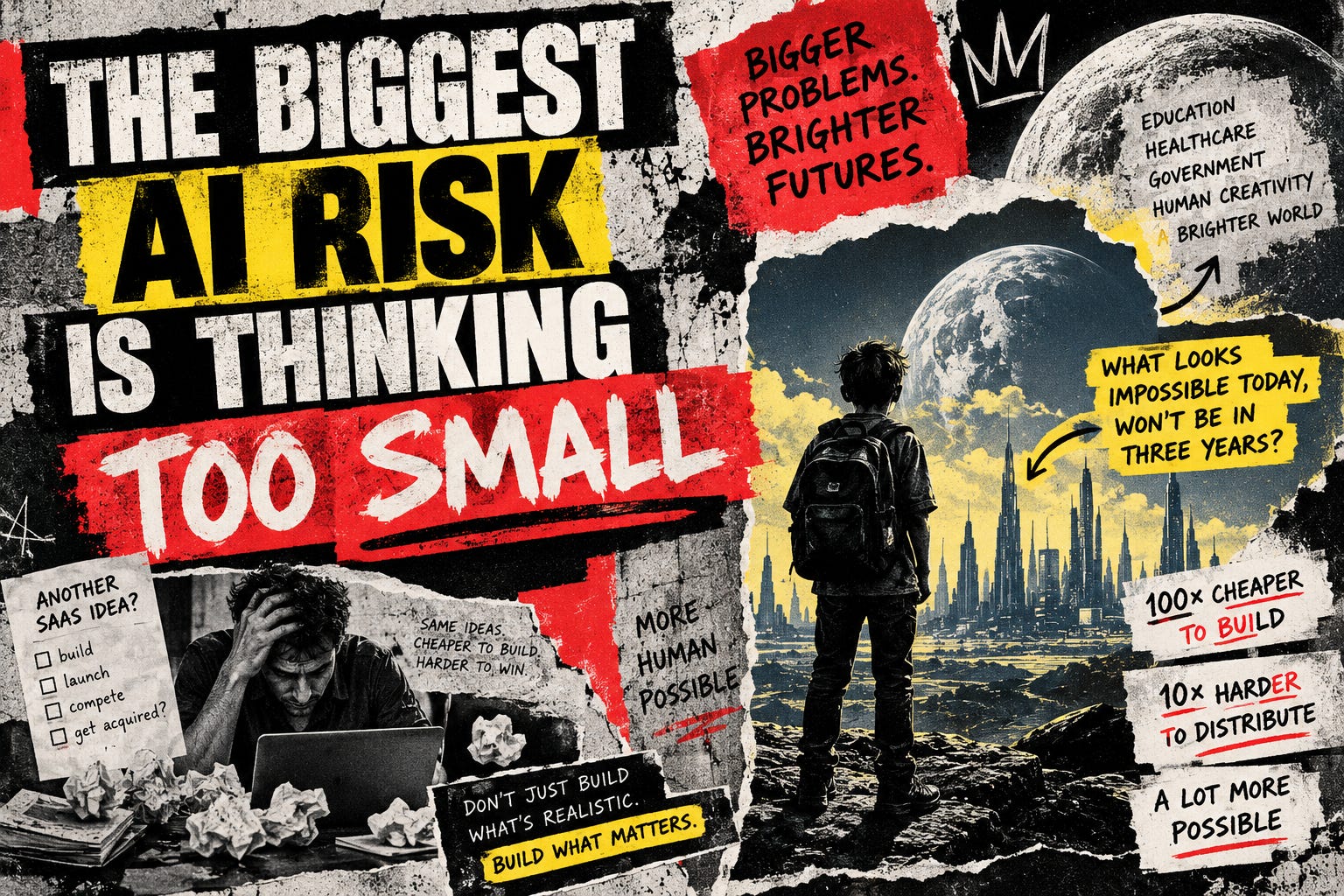
I increasingly think one of the biggest risks in AI right now is surprisingly mundane: spending the next three years building something that isn’t ambitious enough.
Everything that used to qualify as a decent software startup idea is getting cheaper to build every month. Code, design, research, customer support, operations, outbound sales. A surprisingly large part of the company-building stack is becoming accessible to one competent person with good AI tools.
Which also means that “we built good software” is becoming a terrible moat. If your product and competitive advantage are mostly code, and we’re not talking about actual deep tech, somebody else can increasingly reproduce both.
This doesn’t mean moats disappear. A company getting a banking license has a moat. A company deeply embedded with major Hollywood studios has a moat.
Regulation, distribution, proprietary data, physical infrastructure, trusted brands and difficult relationships don’t suddenly disappear because Claude can write excellent TypeScript. But AI also opens a completely different class of opportunities.
Give every child a genuinely personal tutor. Rebuild healthcare around continuous diagnostics and individualized treatment. Redesign government services. Rethink how companies operate, how people use the internet and how media gets created. A few years ago, some of these sounded less like startup ideas and more like things you’d discuss after the third bottle of wine.
Now I’m not so sure. And that’s why I think the dangerous question is: “What can I realistically build today?”
A better one might be: “What important thing looks almost impossible today, but probably won’t be impossible three years from now?”
My rough expectation is that producing good code and content gets something like 100× cheaper, while distribution and sales become dramatically more expensive because everyone else gets the same production superpowers.
Supply explodes. Attention doesn’t. Capital may become more concentrated. So building another perfectly sensible SaaS product may actually be the riskier choice.
We’ve probably never had this much leverage available to individuals and tiny teams. It seems a shame to spend it thinking small.
I think you’ve reached an important vista.
There used to be a US program called the Peace Corps. I sometimes imagine a small program to teach AI and how to think with AI so that communities around the world can unleash it for the good.
For myself, I’m always wondering how I can leverage it in my photography practice in useful ways - and I’m not talking about how most would use AI in photography. I mean things like teaching visual thinking, making learning from the past easier and more productive, creating spaces where communities can easily come together over shared images of space and culture.
But I’m closer to old than I am to young, so I might run out of time.