
The First Herculaneum Scroll Has Finally Been Read
AI, X-rays, and open science have recovered a Stoic text sealed since Vesuvius buried Herculaneum almost two thousand years ago.
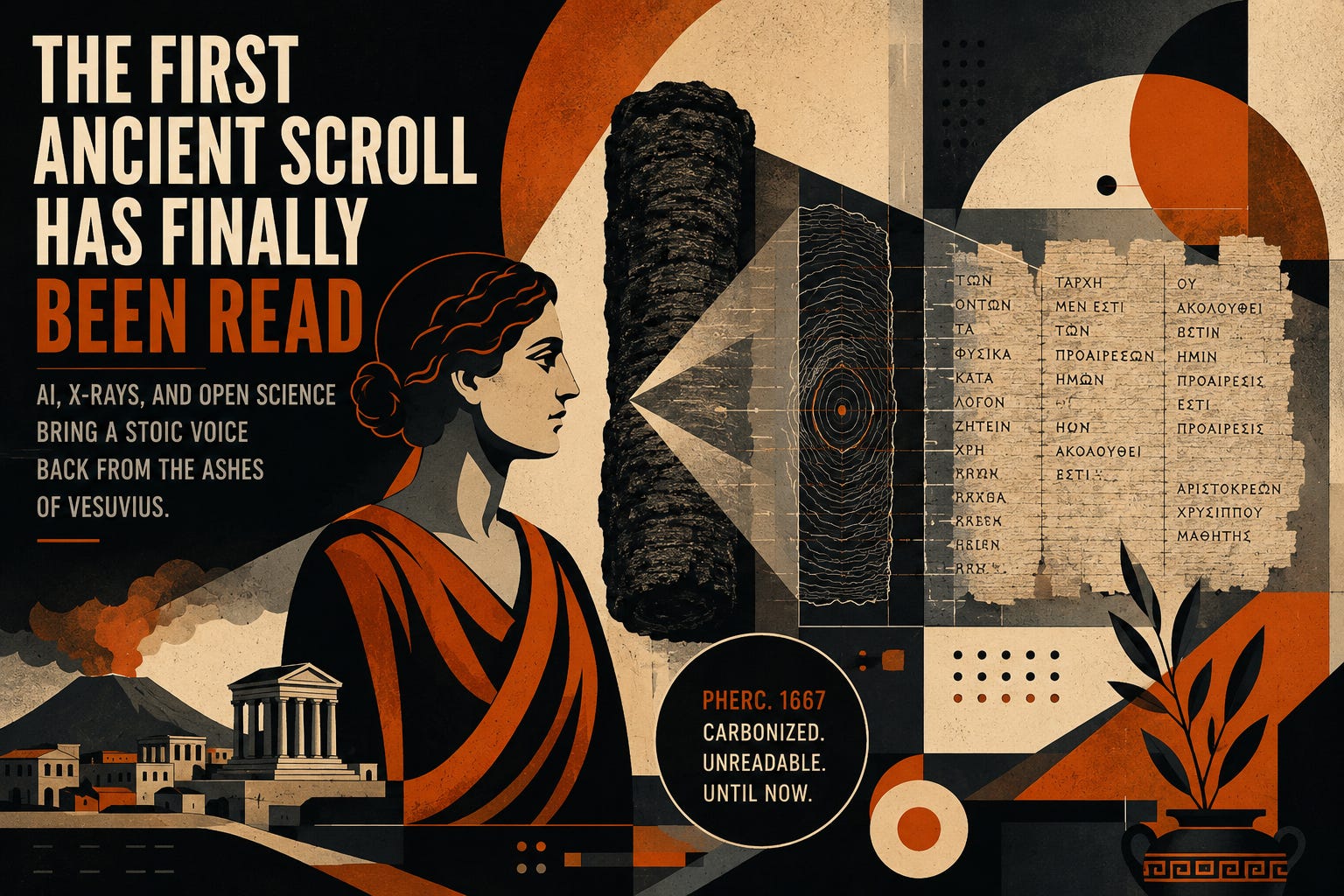
For nearly two thousand years, the Herculaneum scrolls have been playing the most infuriating game in the history of books. They survived. But only by becoming unreadable.
When Vesuvius erupted in AD 79, the library at Herculaneum did not simply vanish. Its papyrus scrolls were carbonized, buried, and preserved as black, fragile cylinders that look less like literature and more like something found at the bottom of a barbecue. This was both a miracle and a cosmic joke.
Open them, and you destroy them. Leave them closed, and you own a library that cannot be read.
Now, for the first time, the Vesuvius Challenge has virtually unwrapped and read an entire surviving Herculaneum scroll. Not a word. Not a few letters. Not a heroic little scrap. A full preserved scroll surface, read end to end.
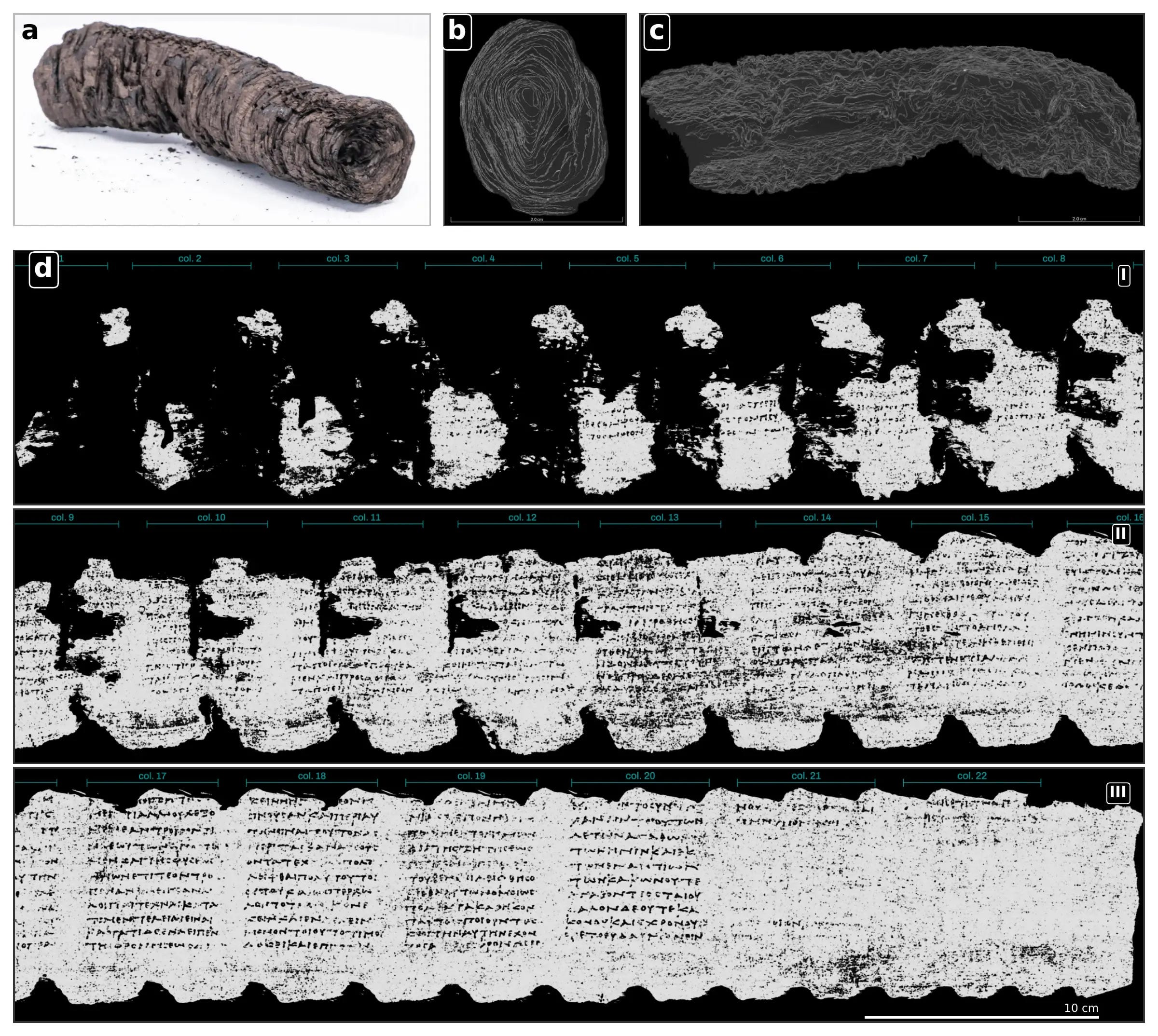
The scroll is PHerc. 1667, also known in the Vesuvius Challenge community as Scroll 4. It was not physically opened. Instead, researchers used high-resolution X-ray microtomography to scan the rolled papyrus, reconstructed the geometry of the wound sheet, flattened it computationally, and then used machine learning to detect traces of ink almost indistinguishable from the carbonized papyrus beneath it. This is the sort of thing that sounds simple only if you say it quickly.
In practice, it is closer to reading a burnt lasagna by mapping every layer, flattening it in software, and teaching a neural network to notice where an ancient Greek letter slightly differs from cooked plant fibre. The result is extraordinary.
PHerc. 1667 was once much larger, probably around 19 to 24 centimeters high. Unfortunately, earlier attempts to open it physically in the nineteenth and twentieth centuries destroyed much of the outer material. What survived is only the compact inner core, about 8 centimeters high. And from that battered little remnant, the team recovered the lower portions of around twenty-two columns of Greek text.
The text appears to be Stoic. Not motivational-poster Stoic. Not “wake up at 5 a.m. and drink cold water because Marcus Aurelius would have used Notion” Stoic. Actual Stoic philosophy.
The recovered work discusses ethics, human nature, impulse, and moral progress. Its final preserved column names Aristocreon, a nephew and disciple of Chrysippus, one of the central figures of early Stoicism. That places the text in the orbit of a philosophical tradition where much has been lost and almost every recovered fragment matters. This is the part that makes the achievement feel bigger than the technology. AI did not merely make an old object look nice in a museum demo. It helped recover a voice from a destroyed intellectual world.
Most ancient texts did not survive because history is not a library with a decent backup policy. Papyrus decays. Fires happen. Empires become enthusiastic about vandalism. Copyists make choices. Monks get tired. Mice contribute their opinions.
The Herculaneum papyri are different. They are a library preserved by disaster. Vesuvius burned them, buried them, and accidentally protected them from the next two millennia.
For centuries, that protection came with a brutal condition: you could keep the scroll, or you could read it. Not both. Virtual unwrapping breaks that bargain.
The Vesuvius Challenge began as an open competition in 2023. The first breakthrough was a single word. Then came passages. Several of the people who won early prizes were later hired to work on the problem full-time. That detail matters. This was not just a laboratory pushing a button marked “AI archaeology.” It was an open, weird, global effort where computer scientists, papyrologists, engineers, contestants, imaging experts, and machine learning people all attacked the same impossible object from different angles.
The machine learning is crucial, but it is not magic. The AI detects signals. Humans still interpret. Scholars still read, check, transcribe, argue, and decide what the text actually says. Which is exactly how this should work. Not AI replacing the humanities. AI giving the humanities a better shovel.
The most important implication is that this is not a one-off miracle. Hundreds of Herculaneum scrolls remain sealed. The team is not stopping. The method is improving. The data and code are open. The pipeline is becoming scalable. So the real story is not only that one scroll has been read.
The real story is that reading new ancient texts may become a regular event. That is a ridiculous sentence.
For most of modern history, “new ancient Greek philosophical text recovered from a sealed Roman library” would be the kind of thing that happened once in a generation, if at all. Now it may become something that appears in updates, preprints, datasets, and release notes.
The past is being moved into the queue. And somewhere inside those black scrolls may be lost philosophy, poetry, science, history, jokes, arguments, bad opinions, brilliant insights, and all the normal noise of human thought that time nearly erased.
The usual AI discourse is full of nonsense about replacing jobs, generating slop, and making another productivity dashboard nobody asked for. Then something like this happens.
A machine helps read a book that no human has read since the Roman Empire. And suddenly the whole enterprise looks less stupid.