
The Great Wrapper Panic
A Nature Medicine study just showed general-purpose LLMs outperforming specialized clinical AI tools.
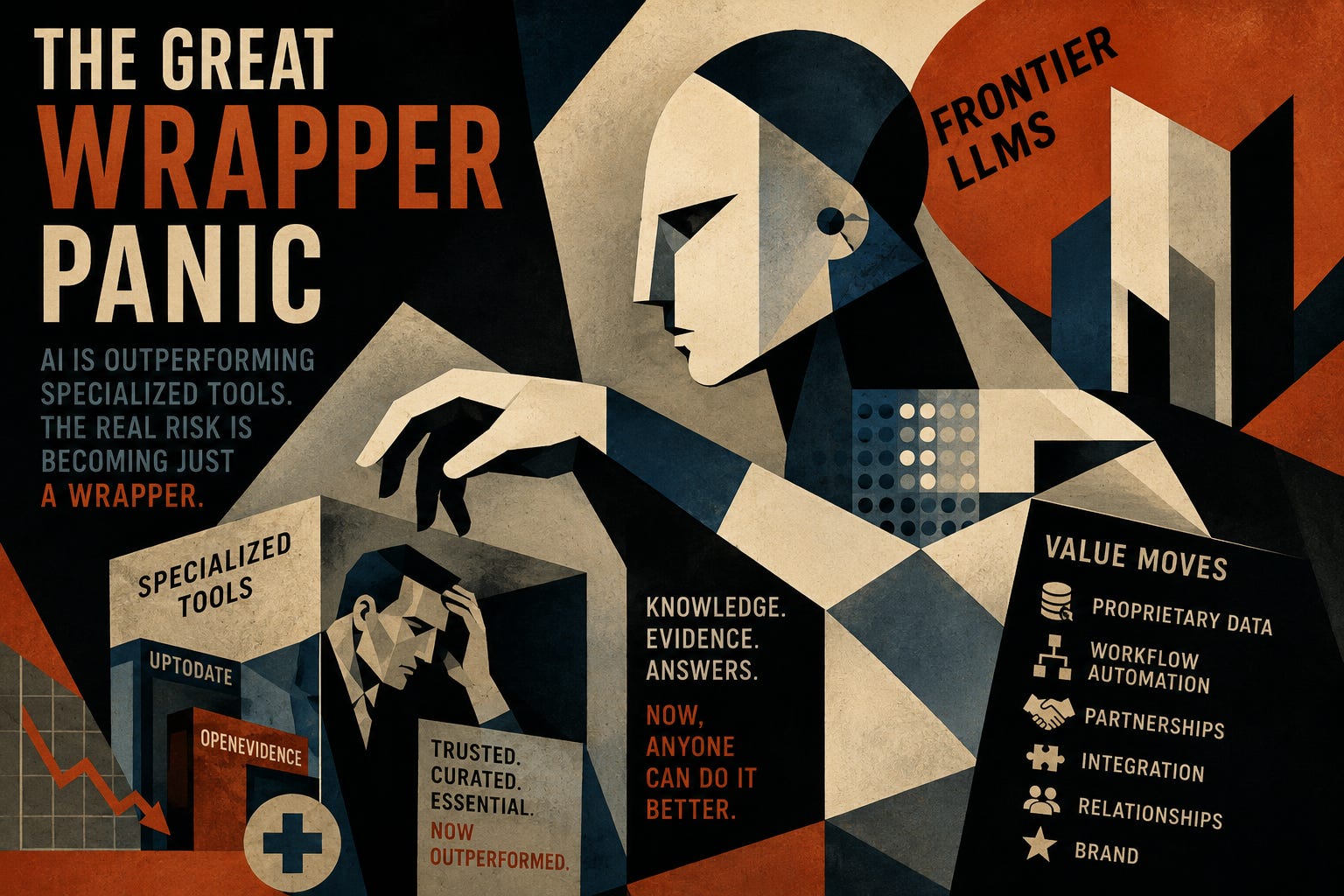
There is a particular kind of business nightmare that arrives very politely. It does not kick the door down. It does not announce itself with a dramatic soundtrack. It simply walks into the room, opens a benchmark, and says:
“Your specialized product is now worse than a general-purpose model.”
Then everyone in the boardroom starts looking at the table.
This is roughly what happened in a recent Nature Medicine study, where researchers compared general-purpose frontier LLMs — GPT, Gemini, and Claude — against specialized clinical AI tools, including OpenEvidence and UpToDate Expert AI.
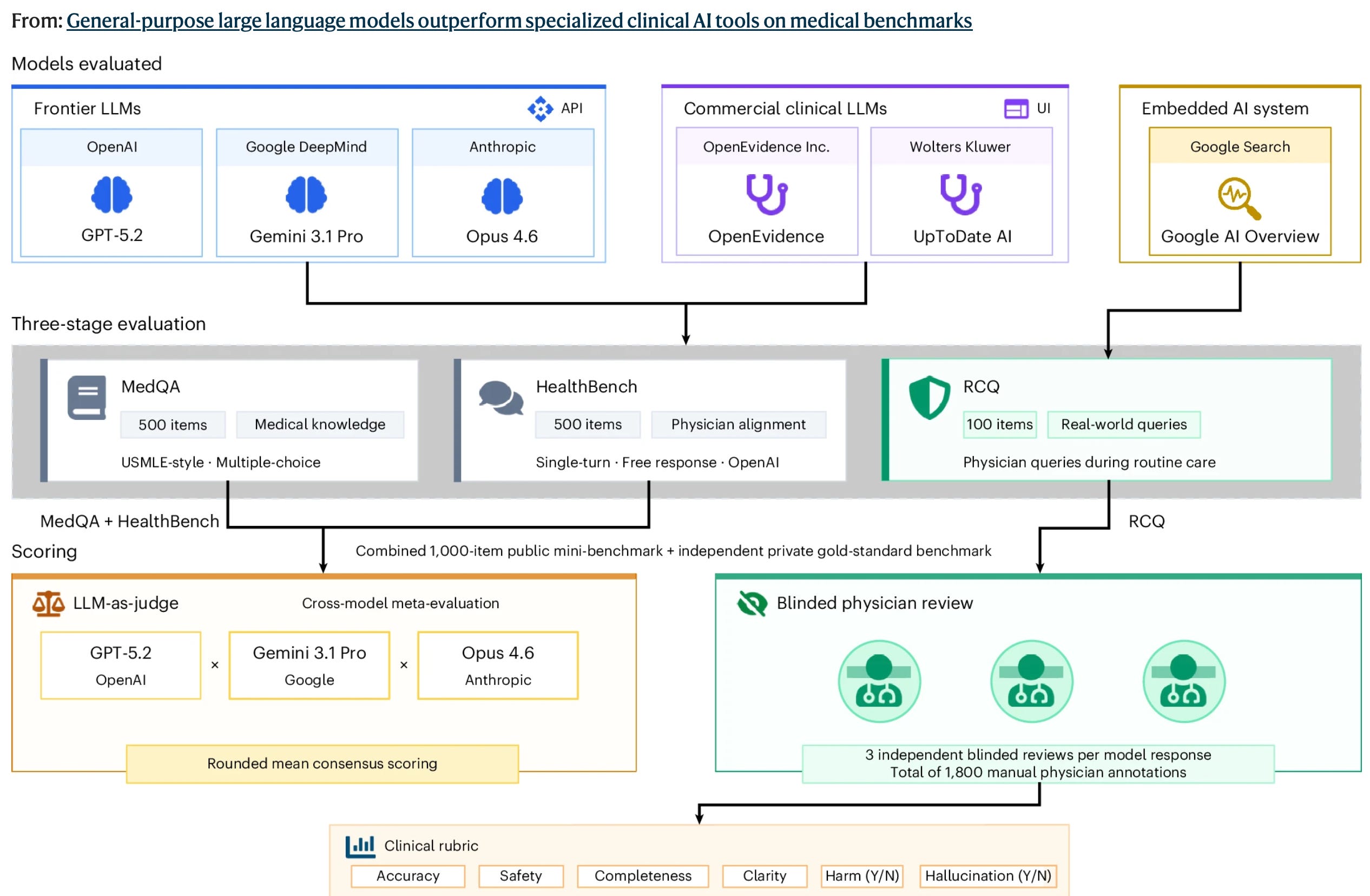
The result was not subtle. The general-purpose models outperformed the specialized clinical products across medical benchmarks and physician-reviewed tasks.
That is quite a sentence. Because OpenEvidence and UpToDate are not random weekend apps built by three founders in a coworking space with a landing page and a dream.
They are serious medical knowledge products. They exist to answer clinical questions. They are built around medical evidence, guidelines, references, expert curation, and the kind of structured clinical knowledge that physicians have relied on for years. And yet, according to the study, the ordinary frontier models — the ones people also use to rewrite emails, debug JavaScript, summarize PDFs, and generate questionable business plans — performed better.
This is not just a healthcare AI story. This is the great wrapper panic.
The Problem With Being the Trusted Interface
For a long time, specialized information services had a strong and very reasonable business case.
The internet was chaotic. Medical knowledge was fragmented. Clinical guidelines changed. Drug references were dense. Doctors did not have time to wander through search results like tourists in a burning library. So products like UpToDate became trusted interfaces to medical knowledge.
They did not merely “answer questions.” They organized expertise. They reduced uncertainty. They gave clinicians a reliable place to go when they needed evidence, context, and guidance.
OpenEvidence entered a similar space with a more AI-native interface.
The proposition was obvious: instead of making clinicians dig through literature manually, give them an AI-powered evidence system that grounds answers in medical sources.
That made sense. It still makes sense. But then general-purpose LLMs improved. And improved. And improved again.
Now the uncomfortable question appears: If GPT, Claude, and Gemini can answer clinical questions better than specialized clinical tools, what exactly is the specialized tool still selling?
That question is not friendly. It is the sort of question that removes oxygen from a product roadmap.
The Irony Is Delicious
The irony is that specialized knowledge services probably helped make this possible.
General-purpose models did not become good at medicine by meditating in a cave. They were trained, tuned, evaluated, aligned, and improved in a world full of structured medical knowledge, clinical guidelines, textbooks, review articles, databases, expert references, and validated content.
The knowledge ecosystem fed the models. Then the models began outperforming parts of the ecosystem. This is not unique to medicine. It is happening everywhere.
Legal databases trained the legal reasoning layer. Coding forums trained coding assistants. Design archives trained visual generation systems. Financial research trained market analysis models. Educational content trained tutoring systems. The internet spent decades creating structured knowledge interfaces.
Now AI models are digesting those interfaces and coming back as cheaper, faster, more general competitors. Very generous of civilization.
The Wrapper Problem
The obvious response for specialized companies is: “Fine. We will integrate frontier LLMs into our product.”
And they should.
They almost have to. If your proprietary medical assistant is being beaten by GPT or Gemini, you do not sit there polishing your old retrieval layer while the building catches fire.
You use the stronger model. You redesign the workflow. You ship better answers. You survive. But this creates a second problem.
Once you use the frontier model inside your product, you risk becoming a wrapper. And “wrapper” is now one of the most terrifying words in technology.
A wrapper is not automatically bad. Many great businesses are wrappers in some sense. A beautiful interface around a powerful engine can be valuable. A workflow layer can be valuable. A compliance layer can be valuable. A product that makes a general technology usable in a specific domain can be extremely valuable. But a thin wrapper is different.
A thin wrapper is just a prettier box around someone else’s intelligence. And if the underlying model provider can reproduce your feature, lower your margin, cut off your access, copy your workflow, or bundle your use case into the base product, you are no longer a business.
You are a temporary UI. That is the fear.
This Is Not Just Healthcare
Healthcare is simply a very clear example because the stakes are high and the domain is well-defined. But the same logic applies to many industries.
Consulting. Design. Legal research. Financial analysis. Market intelligence. Software development. Education. HR. Compliance. Customer support. Strategy. Any company whose main value is “we answer questions using a knowledge base” now has a problem. Because frontier models are becoming very good at answering questions.
Any company whose main value is “we generate a document” has a problem. Because frontier models are becoming very good at generating documents.
Any company whose main value is “we summarize and synthesize information” has a problem. Because that is basically the home territory of modern LLMs.
If your product sits between a user and an answer, you need to ask a deeply unpleasant question: What happens when the model answers directly?
And if the answer is “we add a chatbot,” please remain seated. That is not a strategy. That is a cry for help in product form.
Why Specialized Products Still Matter
Now, before we all declare that every domain product is dead and move into a hut to sell artisanal prompts, let us be clear.
Specialized products are not doomed.
In fact, many may become more important. But only if they stop competing with frontier models on generic question-answering.
That race is stupid. It is like trying to beat a Formula 1 car by adding stripes to your bicycle.
The value has to move elsewhere. The question is no longer: “Can our product answer a medical question?”
The question is: “Can our product make clinical work safer, faster, more integrated, more auditable, and more useful than a doctor simply opening ChatGPT?”
That is a much better question. And it points to where defensibility may still live.
What Actually Creates Defensibility Now
First: unique proprietary data.
This is the strongest moat, and also the rarest. If you have data nobody else has, and that data materially improves decisions, you are in a strong position. Not scraped public content. Not “we have a database.” Real proprietary data. Operational data. Outcome data. Workflow data. Customer-specific data. Institutional data. Hard-to-get data with permission, structure, and ongoing freshness.
In healthcare, that could mean integration with real clinical workflows, local protocols, patient context, outcomes, formularies, care pathways, hospital policies, and feedback loops that general models do not naturally have.
Second: full-chain workflow automation.
Do not just answer the question. Own the workflow.
In medicine, that means moving beyond “what does the evidence say?” toward systems that help doctors triage, document, order, monitor, verify, educate patients, coordinate teams, and close the loop.
A question-answering box is easy to replace. A deeply integrated clinical operating layer is much harder.
Third: partnerships.
One company rarely owns the whole stack anymore.
The defensible product may come from combining hospitals, labs, insurers, EHR systems, medical societies, device companies, research groups, and AI labs into something no single model provider can easily reproduce.
Fourth: deep customization and integration.
If leaving your product requires the customer to rebuild workflows, retrain staff, migrate data, renegotiate compliance, and disturb a dozen departments, you have more protection.
Not perfect protection. But more than a landing page and a model call.
Fifth: relationships.
This sounds old-fashioned because it is. But old-fashioned things often survive because they work.
In enterprise and healthcare especially, trust, procurement access, institutional relationships, regulatory familiarity, and the right phone number still matter.
If two tools are close enough, people buy from the company they trust. Or the company their hospital already approved. Or the company whose sales rep knows exactly which committee must be convinced before anyone touches the software.
Human networks are still infrastructure.
Sixth: brand.
If nobody has your number in their phone, they should at least remember your name by default.
Brand is not a logo. Brand is mental availability.
When someone thinks “medical evidence AI,” do they think of you? When someone thinks “clinical decision support,” do they think of you? When someone thinks “safe AI layer for physicians,” do they think of you?
If not, you are depending on performance marketing in a world where models increasingly intercept intent before users ever search.
Good luck.
The Wrong Response
The wrong response is to panic-build a generic chatbot.
Many companies are doing this. They take their existing product, add a chat box, connect an LLM, and announce that they are now an AI company. This is not transformation. This is interior decoration.
The user does not need another chat box. The user needs a better outcome.
In medicine, a physician does not need a magical answer machine that sometimes sounds confident and sometimes quietly forgets context.
They need evidence, workflow fit, traceability, safety, institutional compliance, local relevance, and integration into the actual clinical process.
The frontier model provides raw intelligence. The product must provide situated value.
That difference is the business.
The Entrepreneurial Moment
This sounds grim. It is. But it is also an enormous entrepreneurial opportunity. Because AI destroys shallow moats but rewards real business design.
A founder who understands a domain deeply now has access to intelligence infrastructure that previously would have required an army. That means the game shifts. Less value in building a clever answer engine. More value in knowing where intelligence should sit inside the work.
Less value in a database. - More value in a living workflow.
Less value in generic expertise. - More value in proprietary context.
Less value in isolated features. - More value in chains of action.
This is why entrepreneurial talent matters more, not less.
AI makes execution cheaper. It does not make judgment free. It does not tell you which workflow matters. It does not automatically create trust. It does not understand your customer’s politics, constraints, incentives, fears, procurement reality, and hidden failure modes.
That is the work. The model is not the company. The company is what you build around the model that customers cannot easily replace.
My Verdict
The Nature Medicine study is important because it reveals a pattern that will repeat across industries.
General-purpose frontier models are no longer toys. They are not merely “good enough” at broad tasks. They are starting to outperform specialized tools in domains where those tools once looked protected.
That does not mean OpenEvidence or UpToDate are finished. It does mean their strategic center of gravity must shift.
The future is not “better medical chatbot versus worse medical chatbot.” - The future is clinical workflow intelligence.
Evidence plus context. Answers plus traceability. Models plus institutional trust. Knowledge plus action.
The same is true in law, finance, consulting, design, software, and education. If your company is just a wrapper around answers, you are in trouble. If your company owns data, workflow, trust, integration, distribution, partnerships, and brand, AI may make you stronger. That is the uncomfortable lesson. The wrapper panic is real. But it is not the end of business.
It is the end of lazy defensibility. And frankly, that may not be the worst thing in the world.
Really strong explanation. Provoked my thinking. Thanks!
This will sound like a wide, oversimplified question: yet is a wrapper today (thin or otherwise) similar to the apps of yesterday? Some more robust in their models than others?