
I’ve written quite a lot about the skills adults should develop for a world with increasingly capable AI. The reason is simple: I think we’re heading into one of the largest macroeconomic shocks of our lifetimes. Not necessarily tomorrow. Not because every company suddenly fires everyone and replaces them with Claude on Monday morning. Technology takes time to diffuse through an economy.
Even if frontier AI progress completely stopped today, it would take years, probably decades, for existing capabilities to work their way through healthcare, government, construction, finance, education, manufacturing, law and the millions of boring companies that still run critical processes through Excel files and email attachments. So the future itself doesn’t particularly frighten me.
The future has always been unpredictable. Technology has always destroyed some things and created others. What worries me is the transition.
The Old Mental Model Is Breaking
A lot of people are entering this transition with a model of life that looks something like this:
born → educated → profession acquired → work → retirement
You learn the thing. You become the thing. Then you spend several decades being the thing. Accountant. Programmer. Designer. Lawyer. Marketer. Manager. There are other assumptions hiding inside this model.
Some people have ideas; other people execute them. Someone above you knows what needs to be done.
Your job is to perform your part well. Organizations provide structure. Institutions tell you which qualifications matter.
Someone, somewhere, probably knows what is happening.
I increasingly don’t believe any of this is a particularly safe assumption. Not because professions disappear completely. Because their boundaries are becoming porous at exactly the same time that execution is becoming extraordinarily cheap. A marketer can build software. An engineer can design an interface. A doctor can analyze datasets. An investor can build research tools. A designer can launch a business without assembling a conventional team. And a sufficiently motivated individual can increasingly do things that required an entire department a few years ago.
That’s a wonderful development. It is also deeply destabilizing.
I Don’t Think AI Makes Humans Useless
I do think it may make a lot of people unwilling to change economically less useful. That’s an important distinction.
If your economic value was primarily that you could execute a well-defined process slightly better than the next person, AI is coming uncomfortably close to that process. If your identity was built around being the person who knows which buttons to press in a particular professional tool, that’s not a great moat either. But humans aren’t simply collections of tasks.
We decide what matters. We build relationships. We take responsibility. We develop taste. We create meaning. We notice things that aren’t yet in the specification. We care about outcomes for reasons that can’t easily be reduced to the next token. The darker risk, in my view, isn’t that AI literally eliminates the need for humans. It’s that some people lose the structure from which they derived meaning.
Work has been an enormous source of identity, status, community and purpose. Take away enough of that quickly enough and giving everyone a sufficiently large UBI payment doesn’t magically solve the psychological problem. Money can replace income. It can’t automatically replace meaning. So if I had to prepare for this transition, I wouldn’t begin by trying to predict the exact profession that survives 2033.
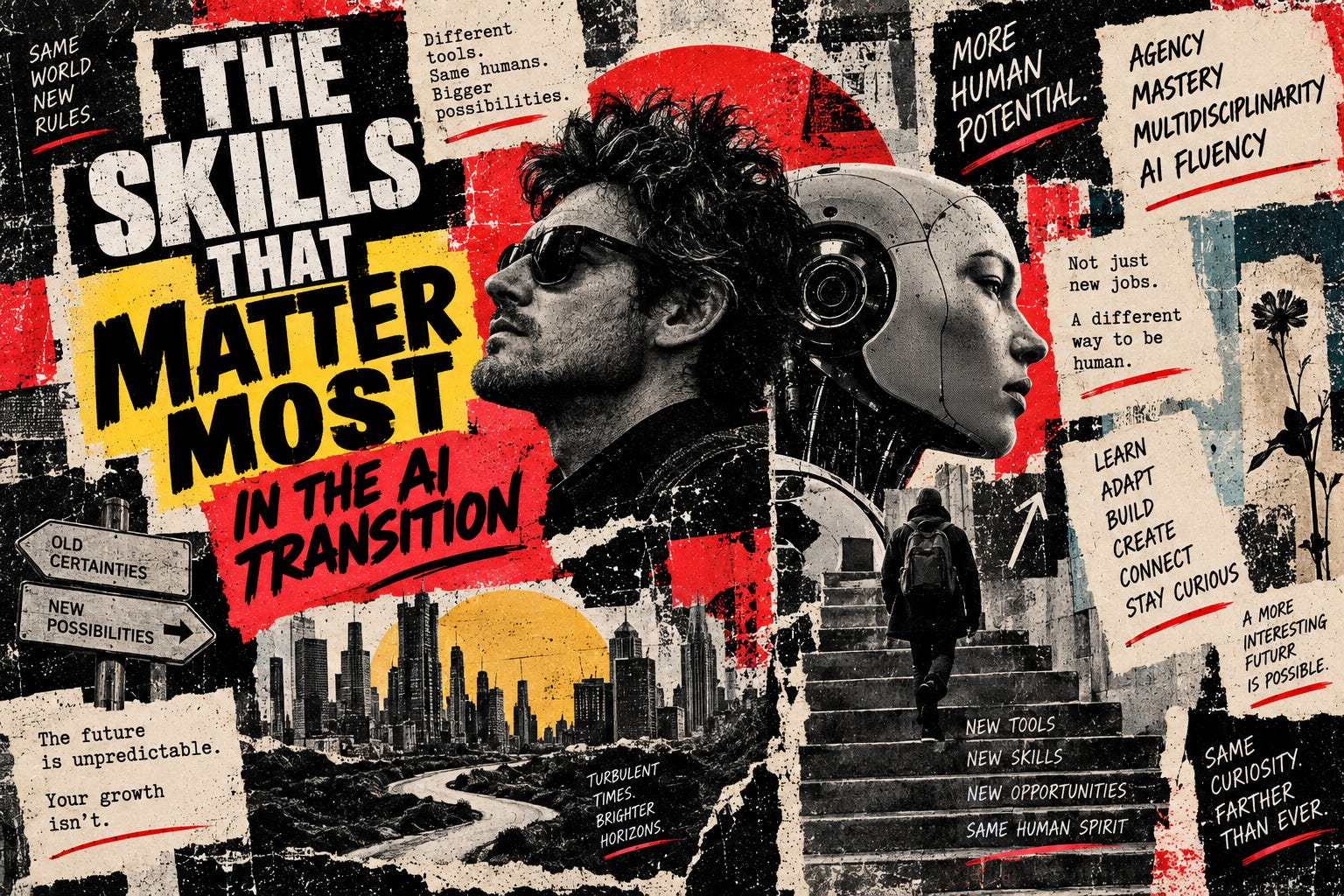
I’d work on the person entering 2033. And there are four qualities I would prioritize.
1. Agency
Agency is the ability to look at a situation and think: Something should happen here. I can make it happen. Without waiting for permission. Without needing a manager to decompose the problem into Jira tickets. Without assuming somebody more qualified will eventually appear. This becomes enormously valuable when execution gets cheap.
If AI gives one person the productive capacity of a small team, then the bottleneck moves upstream. What should we build? Why? Who needs it? What does success look like? What happens next? Agency means accepting responsibility for those questions.
I don’t think this is an innate personality trait. You train it by repeatedly doing things before somebody tells you to.
2. Deep Mastery
This sounds contradictory to the idea that AI can do everything. I think the opposite is true.
When everyone has access to extraordinary tools, knowing what good looks like becomes more important. Give a legendary filmmaker and a random person the same video model and the outputs will not suddenly become equivalent.
The filmmaker understands narrative, pacing, framing, emotion, character, rhythm and thousands of tiny decisions accumulated through years of work.
AI amplifies that. More tokens don’t automatically give you taste. The same applies to programming, mathematics, restaurants, investing, typography, sales or almost anything else.
You need something you understand deeply enough that you can tell when the machine is producing bullshit.
3. Multidisciplinarity
Deep mastery doesn’t mean living inside one professional box forever. I think the valuable combination is increasingly:
depth in one area + working literacy across many others.
You don’t need to become a professional programmer, designer, lawyer, researcher and financial analyst simultaneously. Agents can increasingly handle the technical depth of adjacent fields. But you need enough understanding to connect them.
The interesting opportunities often exist between disciplines. AI makes crossing those boundaries dramatically cheaper. A domain expert who can move comfortably across technology, design, economics, communication and operations suddenly has an enormous surface area for solving problems.
Specialize deeply. Explore broadly. Let agents fill in technical gaps when appropriate.
4. An Intuitive Relationship With AI
Eventually I think “AI skills” will sound as strange as “internet skills.” The important thing isn’t knowing fifty prompting tricks. It’s developing an intuitive sense of what these systems are good at, where they fail, how much context they need, when to delegate, when to inspect, when to use multiple agents and when doing something yourself is simply faster.
AI should become something between a copilot, colleague, research department, slightly unreliable genius friend and, occasionally, annoying cellmate. More importantly, you need a system around it. Not random chats. A workflow that makes you substantially more capable. AI should expand what you can attempt without removing your ownership of the result.
If using AI makes you feel increasingly passive, you’re probably using it wrong.
None of These Skills Are Magic
This is the optimistic part. Agency can be developed. Mastery can be developed. Multidisciplinary curiosity can be developed. Working effectively with AI can obviously be developed. These aren’t lottery tickets you receive at birth.
They’re largely the consequence of desire, deliberate practice and repeatedly putting yourself into situations where you have to grow.
Which is why I feel increasingly connected to the problem of helping people and companies navigate this transition. Not because I know exactly what happens next. I don’t. Nobody does. But turbulent periods are considerably easier when people exchange maps instead of pretending they already know where the road ends. And I remain very optimistic about what comes after the turbulence.
P.S. We May Need to Learn How to Write for Agents, Too
There’s a smaller change I’ve noticed lately that I suspect will become much bigger. As coding agents become more capable, my colleagues and I increasingly send each other agent instructions and Markdown files.
Not:
Hey, can you fix this?
More like:
Here’s the
.md. It contains the problem, context, relevant files, constraints and what the agent should verify. Short version: the migration breaks X.
And then the other person gives the file directly to their agent.
Once you notice this pattern, it makes perfect sense. Why translate a problem into a message for a human, who then translates it into a prompt for an agent?
Send an artifact that works for both. It may eventually become basic professional etiquette. The same way we learned not to send “Hi” on Slack and wait three minutes before explaining what we want. The same way a good bug report includes reproduction steps. The same way decent documentation has an index and links to its sources. Good communication in an agentic workplace may increasingly mean creating context that is simultaneously human-readable and machine-actionable.
Which brings us back to agency. The valuable person isn’t necessarily the one personally performing every step. It’s the person who can understand the problem, create the right context, mobilize humans and machines around it, judge the result and take responsibility for what happens next.
I suspect that’s going to be a pretty useful person to become.