
What Will AGI Actually Look Like?
Most people aren’t arguing about AI. They’re arguing about entirely different timelines.
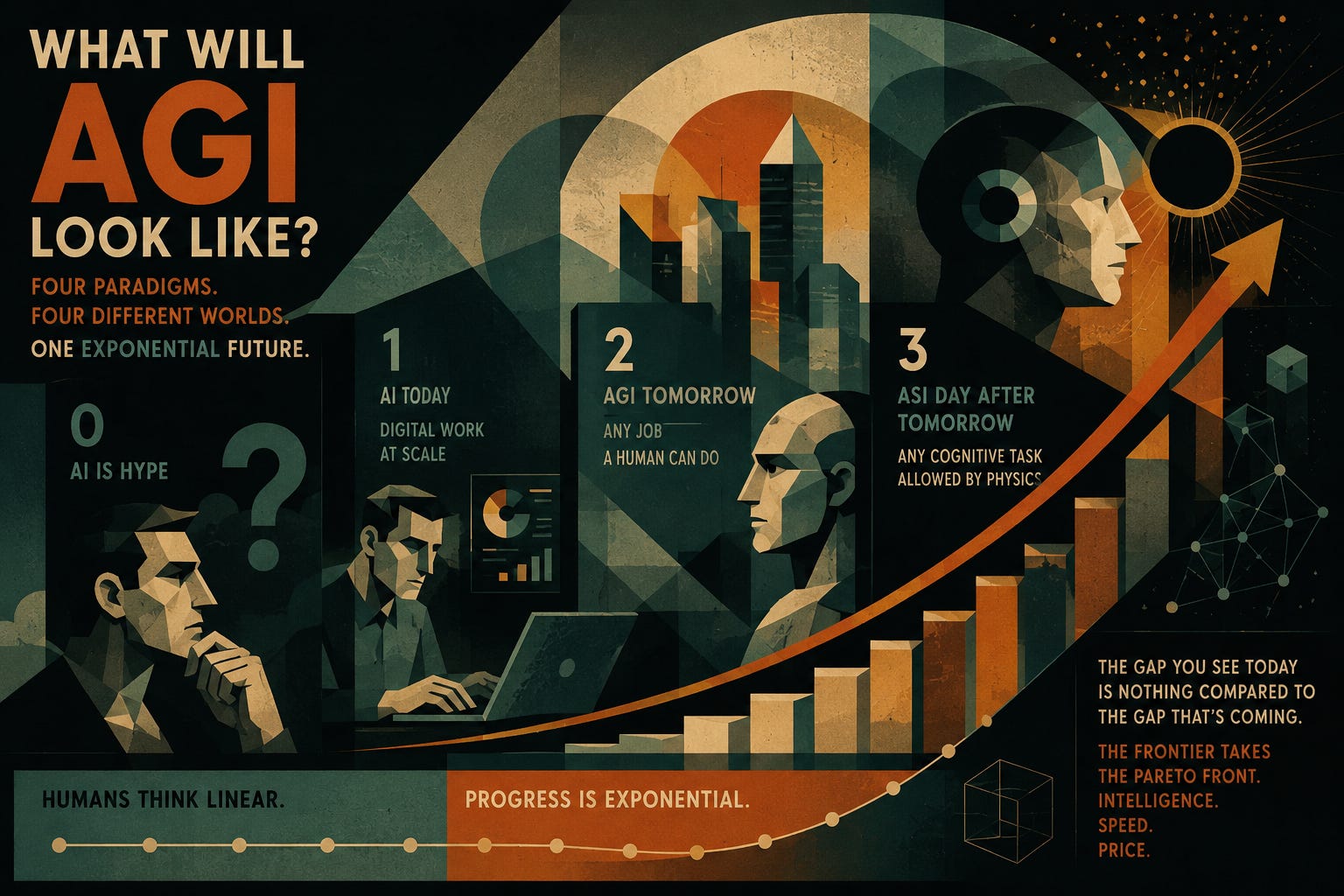
Whenever people debate AI, they usually think they’re talking about the same thing. They’re not.
Most conversations actually mix four completely different paradigms:
0. AI is mostly hype.
1. AI can already perform a large share of digital work.
2. AGI will eventually perform essentially any job a human can.
3. ASI will eventually solve virtually any cognitive task allowed by physics.
People living in different paradigms will never reach agreement, because they’re describing different worlds.
Since GPT-4, one pattern has repeated itself over and over: investors, users, and even many experts have systematically underestimated both the pace of progress and the practical capabilities of frontier models. That’s hardly surprising. Technology often grows exponentially. Humans think linearly.
Every few months I hear some variation of: “Well, Fable is probably close to the ceiling.”
Or: “Surely development has to slow down now.”
So far, reality has been remarkably unimpressed by those predictions.
Another popular assumption is that foundation models will eventually become commodities. Everyone will have roughly the same intelligence layer, and competition will shift elsewhere.
I’m not convinced. Benchmarks hide the biggest differences.
The trillion-dollar impact won’t come from solving one more carefully designed reasoning problem that professors spent weeks creating. It will come from agents that can reliably work for hours instead of minutes: Write software. Run marketing campaigns. Analyze companies. Support customers. Negotiate. Research. Operate continuously with fewer mistakes and less supervision.
Those differences barely show up on a leaderboard, but they compound dramatically in production. And there is another reason why commoditization may be harder than people expect.
The frontier labs are already using AI to build better AI. Recursive self-improvement has quietly become part of the development process. If the best models help create the next generation, the frontier doesn’t just move forward. It accelerates.
The leaders capture more of the Pareto frontier: first intelligence, then speed, and eventually price through competition and scale.
Which means today’s capabilities are, in many ways, the least interesting capabilities these systems will ever have.
The next two years may bring more progress than the previous five.
So when someone asks, “What will AGI look like?”, I usually ask another question: Which world are you imagining?
If you’re in paradigm 0, you’ll say: “It can’t feel emotions or dream. Useless.”
If you’re in paradigm 1, you’ll say: “It’s a pretty good model. Slightly better than the others.”
If you’re in paradigm 2, you’ll ask: “What could a thousand autonomous agents accomplish if they worked together on one problem?”
And if you’re already thinking in paradigm 3, compare today’s frontier agents with GPT-3.
One can work on a business problem for hours. The other forgets what it was talking about after three paragraphs.
Now imagine that same gap happening one more time. That possibility is probably more important than arguing about what AGI should be called.